
Truss-Hung LED Screen Guide
A truss-hung LED screen is a modular LED wall suspended from an approved overhead rigging system rather than supported directly from the floor. The complete suspended system—not only the LED cabinets—must be evaluated for total load, load distribution, rigging points, truss, hoists, hardware, screen dimensions, cable loads, and venue requirements. Industry rigging guidance likewise emphasizes calculating the complete suspended load and verifying individual attachment/point loads rather than relying only on total weight.
Houston LED Screen Rental brings 23+ years of event production experience to LED display planning. We coordinate the LED configuration, screen position, processing, power and signal routing, and production requirements with the applicable rigging plan. Structural capacity, attachment points, hardware, and other safety-critical requirements must be verified for the specific installation by qualified parties.
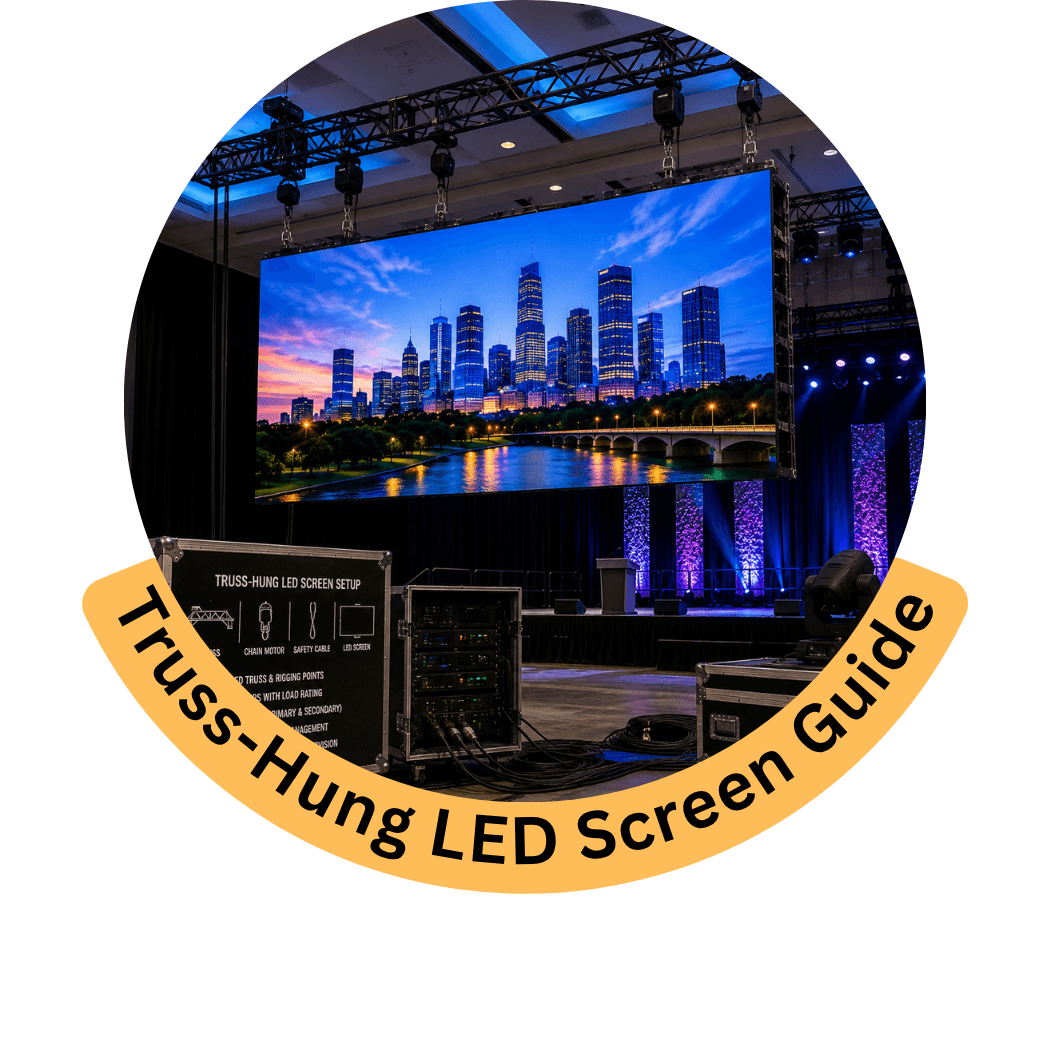
1. What Determines Whether an LED Screen Can Be Truss-Hung?
Whether an LED screen can be suspended depends on the complete system load, available structure, approved attachment points, load distribution, LED configuration, rigging equipment, venue requirements, and production design.
The existence of overhead structure does not automatically mean an LED wall can be suspended from it. Venue coordination and project-specific load verification are fundamental parts of suspended LED planning.
| Factor | What Must Be Evaluated | Technical Impact |
|---|---|---|
| LED Wall | Complete display configuration | Establishes display load |
| Screen Dimensions | Width and height | Influences total system design |
| Rigging Hardware | Complete suspended equipment | Adds to total load |
| Truss | Proposed support configuration | Must support calculated loads |
| Hoists / Motors | Lifting configuration | Must suit engineered system |
| Rigging Points | Approved attachment locations | Determine load distribution |
| Structure | Available structural capacity | Determines feasibility |
| Screen Position | Height and location | Affects rigging design |
| Power & Data | Cable routing | Must integrate with the hang |
| Venue Requirements | Site-specific procedures | Affect approval and installation |
We determine the LED wall dimensions from the event requirements before the final rigging configuration is established. Our LED Wall Size Guide explains the screen-sizing process.
2. How Do We Plan a Truss-Hung LED Screen?
We begin with the required LED display and production position, then coordinate that configuration with the venue, rigging, structural, electrical, and video requirements.
We Determine the LED Wall Configuration
We establish the required screen dimensions, pixel pitch, cabinet configuration, and physical display position.
The wall must first make sense for:
- Audience size
- Viewing distance
- Stage dimensions
- Content
- Cameras and IMAG
- Event layout
- Available production space
We Calculate the Complete Suspended Load
The load calculation must account for more than the LED panels themselves. Rigging guidance recommends considering the LED wall together with supporting hardware, cables, frames, and other suspended components.
The actual calculation uses verified equipment information for the proposed system.
We Determine the Required Rigging Position
We coordinate the desired screen location with the available approved rigging environment.
This includes:
- Screen centerline
- Required elevation
- Stage position
- Audience sightlines
- Lighting positions
- Scenic elements
- Other suspended equipment
The visually preferred position cannot override structural or rigging limitations.
We Verify Available Rigging Points
Available points must be evaluated for their actual approved locations and capacities. Load distribution matters because individual points can experience different loads depending on the rigging geometry.
We do not assume loads divide equally across every attachment point.
We Coordinate Truss and Hoists
The truss, hoists, rigging hardware, and attachment configuration must be appropriate for the calculated installation.
Equipment selection and load calculations are handled according to the actual system rather than using universal capacities.
We Plan Power and Data Routing
Power and data must reach the suspended display without interfering with the rigging system or other production equipment.
We coordinate:
- LED power
- Data distribution
- Processor connections
- Cable paths
- Service loops where required
- Control location
Our LED Power Requirements Guide explains how we calculate electrical requirements from the actual LED configuration.
We Coordinate Installation and Testing
After the approved physical system is installed, our technicians configure the LED canvas, processors, signals, and content before show operation.
3. How Is a Truss-Hung LED Wall Different From a Ground-Supported LED Wall?
The primary difference is how the LED display load is supported.
A truss-hung wall transfers its suspended loads through the approved rigging system into the supporting structure. A ground-supported system transfers loads through an engineered support configuration to the floor or ground.
| Truss-Hung LED | Ground-Supported LED |
|---|---|
| Suspended overhead | Supported from floor/ground |
| Requires approved rigging environment | Requires suitable support footprint |
| Requires suspended-load calculations | Requires ground-support calculations |
| Can preserve stage/floor space | Requires physical support area |
| Position depends on rigging feasibility | Position depends on floor/site feasibility |
| Requires overhead coordination | Requires ground-structure coordination |
Neither method is automatically safer or more appropriate. The correct approach depends on the project-specific conditions.
Our LED Screen Installation Guide covers the broader installation decision.
4. What Loads Must Be Included in a Suspended LED Screen Calculation?
The calculation should consider the complete suspended system, not only the advertised weight of the LED cabinets.
Depending on the design, relevant components can include:
- LED cabinets
- Hanging bars or frames
- Truss
- Rigging hardware
- Cables
- Distribution components
- Other suspended accessories
Exact loads must come from the applicable equipment documentation and project configuration.
Rigging systems also require analysis of how those loads are distributed to the support structure. Structural truss guidance specifically notes that the supporting truss must account for the LED wall plus accessories and cables.
5. Why Are Rigging Point Loads Important?
Rigging-point loads determine how much load is transferred to individual attachment locations. Knowing only the total LED wall weight is therefore insufficient.
The distribution can depend on:
- Number of points
- Point locations
- Screen dimensions
- Truss configuration
- Rigging geometry
- Complete suspended load
- Other structural factors
Rigging guidance also notes that bridle geometry can change the forces applied at individual points, which is another reason simple total-weight division should not replace proper calculations.
Qualified rigging or structural personnel must verify these conditions as applicable.
6. How Does Screen Size Affect Truss-Hung LED Rigging?
Increasing LED wall dimensions generally increases the number of cabinets and can increase the total suspended load. A wider display can also change the truss span and load distribution.
However, physical size alone cannot determine the rigging configuration.
We first establish:
screen dimensions → cabinet configuration → complete equipment load → proposed support configuration → verified rigging design
This prevents the rigging system from being selected before the actual LED configuration is known.
For preliminary display sizing, our LED Screen Size Calculator can help estimate physical screen dimensions.
7. How Does Screen Height Affect a Suspended LED Wall?
Screen height influences both audience visibility and the physical rigging configuration. We determine the desired LED position from stage dimensions, audience sightlines, viewing distance, and production design, then coordinate that position with the feasible approved rigging configuration.
For Houston conferences, corporate events, galas, concerts, and other large productions, suspending the LED wall may help preserve usable stage space and position the display above potential sightline obstructions.
However, the final trim height and position remain subject to the actual venue, structural, rigging, and production requirements.
Our explains how screen position and audience geometry work together.
8. How Does Viewing Distance Affect a Truss-Hung LED Screen?
Viewing distance affects the screen dimensions, pixel pitch, and desired display position, while the approved rigging system determines whether that position can be achieved safely.
We evaluate both the closest and farthest practical viewers when planning the display.
For deeper audiences, suspending the LED wall can help establish an elevated viewing position, but elevation alone does not solve every sightline issue. We also consider:
- Audience depth
- Audience width
- Stage height
- Screen dimensions
- Pixel pitch
- Seating or standing layout
- Scenic obstructions
- Camera positions
- Other suspended equipment
Our LED Viewing Distance Guide explains how audience geometry affects screen sizing and positioning.
9. How Do Power and Data Reach a Suspended LED Wall?
Power and data routing must be coordinated with the approved rigging configuration. We plan these systems alongside the physical LED installation rather than adding cables after the wall has been suspended.
Power Distribution
We calculate electrical requirements from the actual LED equipment and cabinet configuration.
Data Distribution
We establish data paths between the LED processors, distribution equipment, and cabinets.
Cable Routing
Cable routes are planned around the screen, truss, production-control location, and other equipment.
Cable Loads
Where cables or related components contribute to the suspended system, their loads must be included where applicable in the project-specific evaluation.
The complete arrangement must follow the requirements of the equipment, installation, venue, and qualified personnel involved.
10. How Does Event Type Affect Truss-Hung LED Screen Planning?
Event type can change the screen position, dimensions, content workflow, stage configuration, and amount of other production equipment sharing the overhead environment.
| Event Type | Why Suspension May Be Considered | Main Planning Factors |
|---|---|---|
| Corporate Event | Preserve stage space | Presentations, sightlines, stage |
| Conference | Elevated main display | Audience depth, IMAG |
| General Session | Large stage production | Screen position, cameras, content |
| Trade Show | Preserve booth footprint | Approved rigging, booth design |
| Product Launch | Scenic integration | Screen placement, content |
| Gala / Awards | Elevated stage display | Sightlines, IMAG, lighting |
| Concert | Large-format video | Stage, cameras, other rigging |
| Exhibition | Overhead display position | Footprint and approved structure |
These are potential applications, not automatic recommendations for suspended installation.
11. How Do We Coordinate Truss-Hung LED With Lighting and Audio Rigging?
LED screens often share the overhead production environment with lighting trusses, audio systems, scenic elements, banners, and other suspended equipment.
We coordinate the proposed LED position with the broader production plan so one system is not designed independently of the others.
Relevant considerations include:
- Available approved rigging points
- Individual system loads
- Combined structural requirements
- Truss positions
- LED sightlines
- Lighting angles
- Audio placement
- Scenic elements
- Cable routes
- Stage footprint
The appropriate qualified parties must verify structural loading and the final rigging configuration.
12. How Do Venue Rigging Requirements Affect LED Installation?
Venue requirements can determine whether a suspended LED configuration is feasible and how the installation must be coordinated.
Requirements vary by facility and event, so we verify project-specific information rather than applying one Houston-wide rigging procedure.
Depending on the venue, planning may involve:
- Approved attachment locations
- Rigging documentation
- Load information
- Installation procedures
- Scheduling
- Qualified rigging personnel
- Structural or engineering review where required
- Coordination with other production systems
We never assume that a venue permits a particular rigging configuration based on another project’s requirements.
13. How Do We Plan Truss-Hung LED Screens for Trade Shows?
Trade show installations require coordination between the LED wall, exhibit design, overhead footprint, facility requirements, and show schedule.
A suspended LED wall may help preserve booth floor space or position a display above the exhibit, but the installation must fit within the approved production and rigging plan.
We evaluate:
- Booth dimensions
- LED dimensions
- Desired display elevation
- Viewing distance
- Exhibit structure
- Approved overhead locations
- Complete suspended load
- Power and data routing
- Installation schedule
Final rigging requirements depend on the exhibition facility, show organizer, booth design, and actual equipment.
14. How Do We Plan Truss-Hung LED Screens for Corporate Events?
For corporate events and conferences, we integrate suspended LED walls with the stage, presentations, cameras, IMAG, lighting, audio, and scenic design.
We determine the desired screen dimensions and position from the audience and content requirements first.
We then coordinate that display requirement with the feasible rigging environment.
This is especially important for productions using multiple LED walls, side screens, scenic LED elements, or extensive overhead lighting because the complete production must be considered together.
15. What Truss-Hung LED Screen Mistakes Do We Help Prevent?
Suspended LED planning requires the display design and rigging design to work together. Common mistakes occur when one is finalized without considering the other.
Using LED Cabinet Weight as the Total Load
The LED cabinets may represent only part of the complete suspended system.
We work from the actual configured system and account for applicable supporting components.
Assuming Rigging Points Are Interchangeable
Rigging points can have different locations and project-specific limitations.
The proposed configuration must use verified attachment conditions.
Dividing Total Weight Equally Between Points
Actual point loads depend on the rigging configuration and load distribution. They should not be assumed to divide evenly without calculation.
Choosing Screen Position Before Checking Rigging Feasibility
The visually preferred screen position may not align with an approved structural solution.
We coordinate display position with rigging feasibility.
Ignoring Power and Data Routing
Suspended displays still require planned electrical and data infrastructure.
We integrate cable routing into the installation design.
Ignoring Other Suspended Systems
Lighting, audio, scenic elements, and other equipment can affect the overall overhead production plan.
We coordinate LED requirements with the broader system.
Treating Every Venue the Same
Rigging procedures and structural conditions vary between facilities.
We verify requirements for the actual event location.
16. Does Truss-Hung LED Installation Affect Rental Cost?
Yes. A suspended LED installation can affect rental scope because it may require additional rigging equipment, truss, hoists, hardware, labor, venue coordination, engineering or structural review where applicable, and installation time.
The final cost can also depend on:
- LED wall dimensions
- LED equipment
- Pixel pitch
- Rigging configuration
- Installation schedule
- Venue requirements
- Power distribution
- Processing
- Cameras and IMAG
- Technical crew
We therefore price the actual production configuration rather than applying one standard rigging charge to every suspended LED wall.
Our LED Screen Rental Cost Guide explains the broader factors affecting rental pricing.
17. When Is Ground Support More Appropriate Than Truss-Hung LED?
Ground support may be more appropriate when the event has sufficient floor space, the required screen position works with a ground-supported system, or an approved overhead solution is unavailable or unsuitable.
Conversely, suspension may be considered when preserving floor space or achieving an elevated display position is important and an appropriate approved rigging solution is available.
We evaluate both approaches against:
screen requirements + audience sightlines + site conditions + structural feasibility + production layout
Neither method should be selected solely for appearance.
Our LED Screen Installation Guide covers the broader installation-method decision.
18. How Do We Test a Truss-Hung LED Screen After Installation?
After the approved suspended system is installed, we test the complete LED, processing, power, signal, and content workflow before live operation.
Our technicians verify relevant elements such as:
- LED cabinet operation
- Complete LED canvas
- Processor configuration
- Power connections
- Data connections
- Signal distribution
- Presentation sources
- Video playback
- Camera and IMAG feeds
- Content mapping
Physical installation and video-system testing are separate requirements. Both must be completed before the display is ready for production.
19. How Do We Configure Video Processing for a Suspended LED Wall?
We configure video processing according to the final LED dimensions, cabinet arrangement, pixel pitch, and native canvas.
The processor can manage:
Resolution and Canvas Mapping
We map processor outputs to the actual pixel dimensions of the installed LED wall.
Source Scaling
Presentations, videos, graphics, and cameras can be scaled and positioned within the LED canvas.
IMAG
Camera feeds can be displayed full-screen or incorporated into designed layouts.
Multiple Sources
For larger productions, presentation switching, playback, cameras, graphics, or media servers can feed the LED processing workflow.
Suspending the screen does not change the fundamental content requirements, but the physical display and production-control systems still need to be engineered as one workflow.
20. Can Multiple LED Screens Be Truss-Hung?
Yes, multiple LED screens can potentially be suspended when the proposed configuration is supported by an appropriate, project-specific rigging and structural plan.
For productions using a main LED wall with additional displays, we evaluate each system and the overall overhead production environment.
Relevant considerations include:
- Individual screen configurations
- Complete suspended loads
- Screen positions
- Rigging points
- Load distribution
- Truss and hoists
- Lighting and audio systems
- Scenic elements
- Power and data routing
- Audience sightlines
Multiple displays should not be treated as independent installations when they interact with the same structural or production environment.
21. How Do We Handle Power and Signal Redundancy for Suspended LED Systems?
Redundancy requirements depend on the importance of the display, LED equipment, processor architecture, production design, and event requirements.
Where appropriate, we evaluate backup strategies for critical parts of the video workflow, such as:
- Presentation sources
- Playback systems
- Video processing
- Signal paths
- Control systems
Power redundancy, where required, must be designed around the actual electrical system and equipment rather than assumed from a generic configuration.
Our LED Power Requirements Guide explains how we determine electrical requirements from the specific LED system.
22. How Do We Plan Load-In and Installation for a Truss-Hung LED Wall?
Suspended LED installation requires coordination between the venue schedule, rigging work, LED assembly, power, signal distribution, testing, and other production departments.
A typical workflow may involve:
equipment delivery → rigging preparation → approved support-system installation → LED assembly → lifting according to the approved plan → power/data connection → processing configuration → testing → rehearsal
The exact sequence depends on the venue, equipment, rigging plan, production schedule, and other systems being installed.
For Houston venues, we verify project-specific access and scheduling rather than assuming identical load-in procedures across facilities.
23. How Do We Plan the Strike of a Truss-Hung LED Screen?
Strike is planned with the same attention to coordination as installation. The suspended display must be removed according to the applicable approved rigging and production procedures.
The workflow can include:
system shutdown → signal and control removal → appropriate power disconnection → preparation for lowering → controlled lowering → LED disassembly → rigging removal → equipment pack-out
The sequence must also coordinate with lighting, audio, scenic, staging, and other production departments sharing the work environment.
24. What Must Be Verified Before an LED Wall Is Suspended?
Before an LED wall is suspended, the complete proposed system must be evaluated for the actual equipment, structural environment, rigging configuration, screen position, electrical requirements, and production conditions.
| Requirement | What Must Be Verified |
|---|---|
| LED Wall Dimensions | Final physical configuration |
| LED Equipment | Actual cabinet system |
| Complete Suspended Load | Applicable equipment and components |
| Truss | Project-specific configuration |
| Hoists / Motors | Appropriate lifting system |
| Rigging Hardware | Appropriate equipment |
| Rigging Points | Approved attachment locations |
| Structural Capacity | Suitability for proposed loads |
| Load Distribution | Loads transferred through the system |
| Screen Position | Approved location and elevation |
| Audience Sightlines | Practical viewing conditions |
| Other Suspended Systems | Lighting, audio and scenic coordination |
| Power | Equipment-specific electrical requirements |
| Data / Signal | Processor-to-display routing |
| Venue Requirements | Project-specific procedures |
| Engineering | Required review where applicable |
| Installation Schedule | Rigging, LED build and testing |
| Strike | Safe removal workflow |
The critical distinction is that LED wall weight alone does not establish whether a screen can be suspended. The complete system, individual load paths, supporting structure, rigging equipment, attachment conditions, and applicable requirements must be evaluated.
If the display dimensions have not yet been established, our LED Screen Size Calculator can provide an initial sizing estimate. We then verify the proposed dimensions against viewing distance, content, stage design, and installation requirements.
For broader installation planning, see our LED Screen Installation Guide. Screen dimensions should also be coordinated with the LED Viewing Distance Guide before the final suspended configuration is developed.
For a Houston event, provide the venue, event date, approximate LED wall dimensions, desired screen position, stage information, and any available rigging documentation. Our production team can define the LED and video requirements and coordinate the suspended-display requirements with the appropriate venue, rigging, structural, and other qualified personnel.