
Outdoor LED Screen Guide
An outdoor LED screen must be configured around daylight visibility, audience viewing distance, screen dimensions, weather exposure, structural support, installation method, power distribution, content, and site conditions. Outdoor production requires more than selecting a bright LED panel.
Houston LED Screen Rental brings 23+ years of event production experience to outdoor LED planning. We evaluate the event site, audience, screen position, ambient light, access, power, signal workflow, structural requirements, and operating schedule before specifying the system. Because equipment and site conditions vary, structural, electrical, ballast, rigging, and weather-related requirements must always be verified for the actual installation.
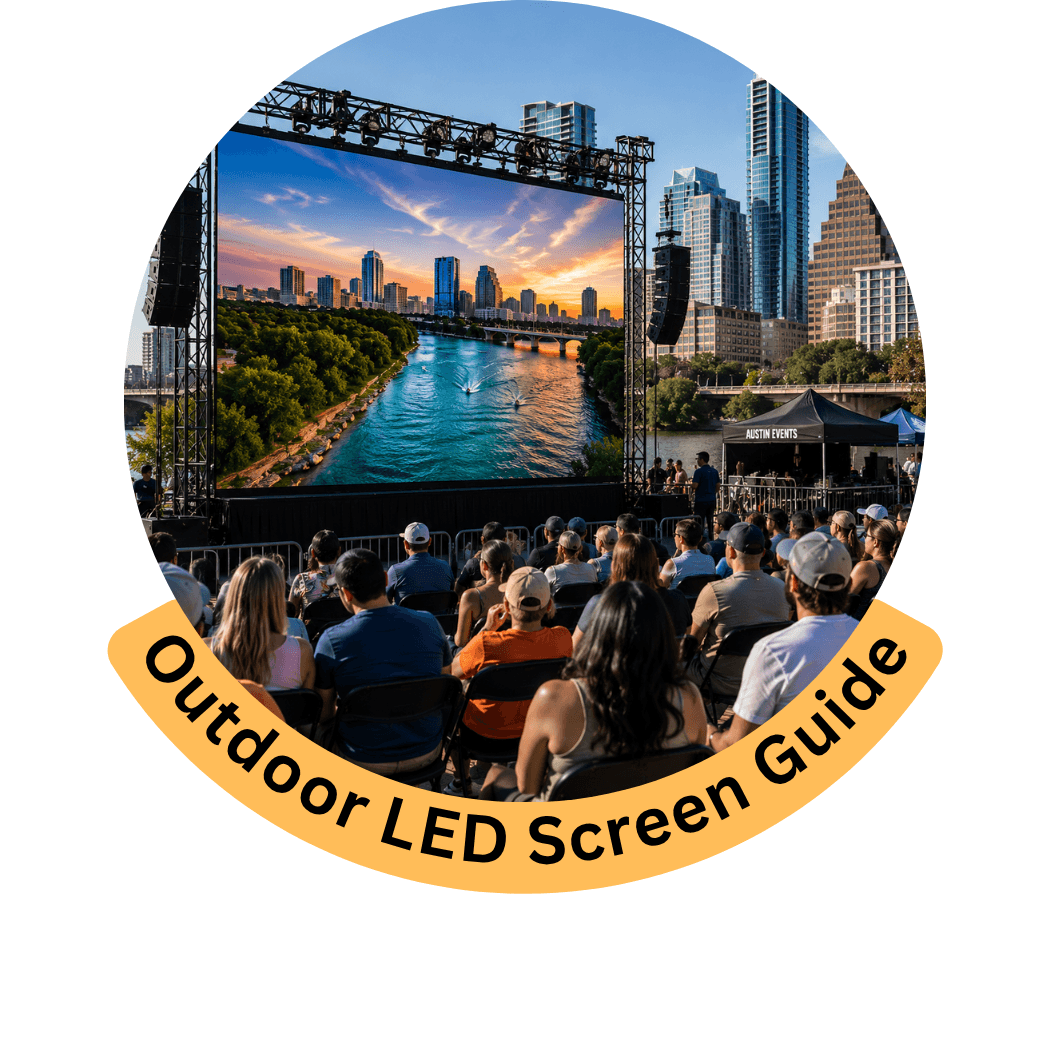
1. What Do We Evaluate Before Selecting an Outdoor LED Screen?
We evaluate the audience, viewing distance, daylight conditions, screen size, pixel pitch, installation method, weather exposure, power availability, content, and event site. These factors determine what type of outdoor LED configuration is appropriate.
| Factor | What We Evaluate | Technical Impact |
|---|---|---|
| Audience | Width, depth and viewing areas | Screen scale and positioning |
| Viewing Distance | Closest and farthest viewers | Screen size and pixel pitch |
| Ambient Light | Daylight and screen orientation | Brightness requirements |
| Screen Dimensions | Required width and height | Visibility and system scale |
| Weather Exposure | Actual site conditions | Equipment and installation planning |
| Installation | Support and positioning | Structural requirements |
| Power | Available electrical service | Distribution planning |
| Content | Video, graphics, IMAG, information | Resolution and processing |
| Site Access | Equipment and installation access | Deployment planning |
| Cameras | Live production requirements | IMAG and signal workflow |
For events where audience distance is a major factor, our LED Viewing Distance Guide explains how viewing conditions affect display selection.
2. How Do We Configure an Outdoor LED Screen for an Event?
We configure an outdoor LED system by evaluating the complete production environment rather than treating the display as standalone equipment.
We Evaluate the Event Site
We review the proposed screen location, audience area, stage, equipment access, surrounding structures, viewing direction, available footprint, and production control positions.
Outdoor Houston environments can vary considerably—from festivals and sporting events to community programs, concerts, corporate activations, and public viewing events.
We Determine Screen Dimensions
We size the display according to audience width and depth, viewing distance, content, available installation area, and screen position.
A larger audience does not automatically require the largest possible screen. We determine dimensions according to how the display will actually be viewed.
Our LED Wall Size Guide covers screen-sizing factors in greater detail.
We Select Pixel Pitch
Pixel pitch is selected according to the closest practical viewing distance, physical screen dimensions, content detail, and required native resolution.
For audiences positioned farther away, an extremely fine pixel pitch may provide little practical benefit. Our LED Pixel Pitch Guide explains this relationship further.
We Evaluate Brightness
Outdoor displays must remain visible under the expected ambient-light conditions.
We evaluate daylight exposure, screen orientation, event timing, viewing conditions, and the actual brightness capability of the proposed LED equipment rather than applying one universal brightness specification to every outdoor event.
We Determine the Installation Method
Depending on the production, an outdoor display may use an appropriate ground-supported structure, approved rigging configuration, or Mobile LED Trailer.
The installation method must be evaluated for the specific screen, site, structure, equipment, and environmental conditions.
We Verify Power Requirements
Outdoor LED walls can require substantial production power, but electrical demand varies by equipment and configuration.
We calculate requirements from the actual LED cabinets, processors, supporting equipment, operating configuration, and manufacturer data. See our LED Power Requirements Guide for deeper power-planning information.
We Plan Signal Distribution
We determine how presentations, cameras, graphics, playback systems, live feeds, and other sources reach the LED processor and display.
Longer outdoor cable paths or distributed production areas can require additional signal-planning considerations.
We Test the Complete System
Before live operation, our technicians test the LED wall, processors, content, cameras, signal paths, playback systems, and supporting production equipment.
3. How Bright Does an Outdoor LED Screen Need to Be?
An outdoor LED screen needs enough usable brightness to maintain appropriate visibility under the actual ambient-light conditions. There is no single brightness value that should be applied universally to every outdoor event.
We evaluate:
- Direct or indirect daylight
- Screen orientation
- Event time
- Audience position
- Surrounding ambient light
- LED product capability
- Content characteristics
- Operating conditions
A daytime outdoor production can require a different display configuration from an evening event at the same site.
Brightness should therefore be treated as a system-selection factor rather than an isolated specification.
4. How Does Viewing Distance Affect an Outdoor LED Screen?
Viewing distance affects both physical screen size and pixel-pitch selection. Distant audiences need sufficient image scale, while closer viewers require appropriate pixel density.
We consider the closest and farthest practical viewing positions.
For example, an outdoor audience spread across a large field or festival environment may require greater physical display scale than a compact outdoor corporate activation.
However, increasing pixel density alone does not make a physically small screen easier to see from a long distance.
5. How Do Weather Conditions Affect Outdoor LED Screen Planning?
Weather conditions can directly affect outdoor LED equipment, structural planning, installation, operation, and event procedures. We evaluate the actual equipment, site, support system, and forecast conditions rather than applying universal weather limits.
Houston outdoor events can involve changing conditions, including heat, rain, wind, and strong daylight. The production plan therefore needs to account for environmental exposure from the beginning.
Weather-Rated Equipment
We verify that the proposed LED equipment is appropriate for its intended outdoor use based on the applicable manufacturer specifications and system configuration.
Wind Exposure
Wind loads and operational limits depend on the display, support structure, dimensions, installation method, site, and engineering requirements.
We do not apply an invented universal wind limit. Required structural calculations, ballast, operational limits, and engineering approval must be established by qualified parties for the specific system where applicable.
Rain Exposure
Outdoor equipment selection, electrical distribution, connectors, cable routing, and operating procedures must account for the expected environment and the specifications of the equipment being deployed.
Heat and Direct Sunlight
We consider equipment operating requirements, direct solar exposure, ambient conditions, ventilation, screen orientation, and manufacturer specifications when planning the system.
6. How Do We Determine the Right Outdoor LED Screen Installation Method?
We determine the installation method from the screen dimensions, event site, audience layout, available footprint, stage design, structural requirements, access, and environmental exposure.
Ground-Supported Outdoor LED
A ground-supported configuration can provide flexible modular screen dimensions where an appropriate support system and footprint are available.
We evaluate the complete structure rather than only the LED panel weight.
Truss-Hung Outdoor LED
Suspended outdoor LED requires detailed coordination of the display, truss, motors, rigging hardware, approved attachment points, structural loads, environmental conditions, and venue/site requirements.
Structural and rigging requirements must be verified by qualified parties for the actual installation. Our Truss-Hung LED Screen Guide explains these considerations further.
Mobile LED Trailer
A Mobile LED Trailer can be appropriate when the event needs an elevated outdoor display with a mobile deployment platform.
We evaluate trailer access, positioning, audience orientation, screen dimensions, viewing distance, site conditions, content, and operating requirements before recommending this configuration.
7. What Is the Difference Between an Outdoor LED Wall and a Mobile LED Trailer?
An Outdoor LED Wall provides greater flexibility in custom dimensions and integration, while a Mobile LED Trailer uses a display integrated into a mobile platform. The better option depends on the site, audience, required screen dimensions, installation schedule, and production design.
| Requirement | Outdoor LED Wall | Mobile LED Trailer |
|---|---|---|
| Screen Configuration | Modular/customizable | Based on trailer configuration |
| Installation | Requires appropriate support | Integrated mobile platform |
| Stage Integration | Highly configurable | Position-dependent |
| Deployment | Built for the production | Mobile deployment |
| Site Access | Equipment/load-in access | Trailer access required |
| Positioning | Based on support design | Based on trailer placement |
| Best Application | Custom outdoor production | Suitable mobile outdoor events |
Neither solution is automatically better or less expensive. We compare the complete production requirement before selecting the appropriate system.
8. How Does Event Type Affect Outdoor LED Screen Requirements?
Event type affects screen dimensions, positioning, viewing distance, brightness, cameras, signal workflow, installation, and technical operation. We configure the outdoor LED system around how the audience will use the display rather than applying the same setup to every event.
| Event Type | Typical Configuration | Main Considerations |
|---|---|---|
| Concert | Outdoor LED Wall | IMAG, audience depth, stage integration |
| Festival | LED Wall / Mobile LED Trailer | Daylight, viewing area, positioning |
| Sporting Event | Outdoor LED / Mobile LED Trailer | Live feeds, audience sightlines |
| Fan Zone | Mobile LED Trailer / Outdoor LED | Viewing distance, live content |
| Community Event | Outdoor LED / Mobile LED Trailer | Audience area, access, operation |
| Brand Activation | Outdoor LED Wall | Close viewing, content, footprint |
| Graduation | Outdoor LED Wall | IMAG, audience depth, sightlines |
| Corporate Outdoor Event | Outdoor LED Wall | Presentations, branding, cameras |
These are configuration approaches, not fixed packages. We determine the actual system from the event site and production requirements.
9. How Do Cameras and IMAG Work With Outdoor LED Screens?
Cameras and IMAG allow an outdoor LED screen to show live speakers, performers, ceremonies, sporting activity, or other program content. We integrate cameras when audience distance makes the live subject difficult to see clearly.
Our production team evaluates camera positions, switching, image composition, signal routing, screen destinations, and operator requirements.
For larger outdoor audiences, screen size and IMAG should be planned together. A properly sized display gives the live camera image enough physical scale to remain useful farther from the stage or activity area.
10. How Do We Manage Video Processing and Content Outdoors?
We configure video processing around the LED wall’s native canvas and the sources feeding it. These may include cameras, presentations, videos, graphics, sponsor media, live feeds, and playback systems.
LED Canvas Mapping
We map content to the actual pixel dimensions of the LED display so graphics and video are positioned correctly.
Source Scaling
Video processors can scale compatible sources to the required LED canvas while maintaining appropriate proportions.
Camera Switching
For live productions, we integrate camera feeds with playback, graphics, and other sources through the video workflow.
Content Visibility
Outdoor content should also account for viewing distance and environmental conditions. Small text or overly detailed layouts may be difficult for distant audiences even when the display itself has sufficient resolution.
11. How Do We Plan Power for an Outdoor LED Screen?
We calculate outdoor LED power requirements from the actual LED equipment, screen configuration, processing equipment, supporting production systems, and manufacturer electrical data. We do not apply a universal electrical-load assumption.
We verify:
- LED cabinet quantity
- Equipment specifications
- Screen configuration
- Processing equipment
- Camera and video systems
- Available electrical service
- Distribution requirements
- Cable routing
- Supporting production loads
Outdoor electrical distribution must also be appropriate for the environment and installation. Qualified personnel should handle electrical work where required.
Our LED Power Requirements Guide explains how we calculate and verify production power.
12. What Outdoor LED Screen Planning Mistakes Do We Help Prevent?
Outdoor LED planning problems often occur when screen selection is based only on physical size. We evaluate the complete site, audience, environment, structure, power, and production workflow.
Selecting the Screen Before Evaluating Viewing Distance
A display can be technically large yet still be unsuitable for the actual audience layout.
We evaluate audience width, depth, and viewing positions before determining dimensions. Our LED Screen Size Calculator can provide an initial estimate before project-specific verification.
Treating Brightness as the Only Outdoor Requirement
Brightness is important, but outdoor suitability also depends on equipment rating, positioning, weather exposure, structure, power, signal routing, and installation.
We evaluate these factors as one system.
Using Pixel Pitch to Compensate for an Undersized Screen
A finer pixel pitch increases pixel density but does not make a physically small image easier to see from a distant audience position.
We determine screen dimensions and pixel pitch separately, then verify how they work together.
Ignoring Screen Orientation
Screen direction can affect daylight exposure and audience visibility.
We evaluate the proposed position and orientation as part of site planning.
Planning Structural Support Too Late
Outdoor structures require project-specific evaluation. Screen dimensions, support equipment, environmental loads, ballast where applicable, and structural requirements must be established for the actual installation by qualified parties.
Assuming Power From Screen Size Alone
Two LED systems of similar physical size may have different electrical requirements.
We verify power from the equipment being deployed.
Ignoring Signal Distance
Outdoor event sites can place cameras, control positions, stages, and displays significant distances apart.
We plan signal distribution around the actual site layout rather than assuming indoor-style cable distances.
13. Which Outdoor LED Display Solution Is Right for Different Requirements?
The appropriate solution depends on screen dimensions, site access, audience layout, installation method, event schedule, content, and production design.
Outdoor LED Wall
We use modular Outdoor LED Walls when the production requires configurable screen dimensions, stage integration, or a specific display position.
They are relevant for concerts, festivals, sporting events, graduations, community programs, and larger outdoor productions.
Mobile LED Trailer
We use Mobile LED Trailers where the integrated mobile display format fits the site and audience requirements.
They can be effective for fan zones, watch events, festivals, community programs, sporting events, and other suitable outdoor productions.
LED Poster
Outdoor use should never be assumed from the product category alone. If an LED Poster is proposed for an outdoor application, we verify that the specific equipment is rated and suitable for the intended environment.
14. How Does Outdoor LED Screen Size Affect Rental Cost?
Screen size affects rental cost because larger modular displays generally require more LED cabinets and can increase processing, structural support, power distribution, transportation, installation labor, and technical staffing.
However, physical size is only one factor.
Outdoor LED rental scope can also be affected by:
- Pixel pitch
- Display type
- Installation method
- Site access
- Rental duration
- Cameras and IMAG
- Processing
- Power requirements
- Technical crew
- Supporting AV
Our LED Screen Rental Cost Guide explains how these variables contribute to the complete rental configuration.
15. Does Outdoor LED Installation Require More Planning Than Indoor LED?
Often, yes. Outdoor installations can introduce environmental, structural, electrical, access, and site-layout considerations that may not apply in the same way to an indoor ballroom or conference environment.
We evaluate the complete outdoor deployment, including screen position, support method, site access, weather exposure, power, signal paths, audience areas, installation schedule, testing, and removal.
The exact requirements still depend on the project. An outdoor Mobile LED Trailer and a large ground-supported modular LED wall, for example, involve very different deployment workflows.
Our LED Screen Installation Guide explains how we plan installation methods around the actual production environment.
16. How Does Screen Position Affect Outdoor LED Visibility?
Screen position directly affects audience sightlines, viewing distance, daylight exposure, and content visibility. We position outdoor LED screens around the actual audience area rather than selecting placement only from available site space.
We evaluate:
- Audience width and depth
- Closest and farthest viewing positions
- Screen elevation
- Stage position
- Viewing angle
- Potential obstructions
- Daylight direction
- Camera positions
- Production control locations
For larger Houston outdoor events, screen elevation can be particularly important when attendees extend deep into the event site. Positioning must still comply with the requirements of the specific support system and installation.
17. Does Pixel Pitch Matter for Large Outdoor Audiences?
Yes, but pixel pitch must be considered together with viewing distance and physical screen size. For audiences positioned farther from an outdoor LED screen, an extremely fine pixel pitch may provide limited practical benefit.
We determine pitch from the closest practical viewing position, screen dimensions, content detail, and required native resolution.
A finer pitch increases pixel density. It does not replace the need for sufficient physical screen dimensions for distant viewers.
Our LED Pixel Pitch Guide explains how we make this selection.
18. How Does Content Design Affect Outdoor LED Screen Visibility?
Outdoor content should be designed around the physical screen size, audience distance, LED canvas, and viewing environment. Content that works on a laptop or indoor presentation screen may not remain readable across a large outdoor audience area.
We consider:
Text Size
Important text needs sufficient physical scale for the intended viewing distance. Dense layouts and small text can reduce readability.
Contrast
Content should maintain clear visual separation under the expected ambient-light conditions.
Graphics and Branding
Logos, sponsor graphics, scores, schedules, and event information should be sized around how far the audience is positioned from the display.
Live Camera IMAG
For concerts, graduations, sporting events, and public programs, IMAG can use more of the available canvas so distant attendees receive a useful view of the live activity.
Native LED Canvas
We map graphics and video to the final LED resolution so important content is positioned correctly without unnecessary cropping or distortion.
19. What Must Be Verified Before a Truss-Hung Outdoor LED Screen Is Installed?
A truss-hung outdoor LED screen requires project-specific verification of the display load, support system, rigging equipment, attachment conditions, environmental loads, and applicable site or venue requirements.
Depending on the installation, qualified parties may need to verify:
- Complete suspended load
- LED wall configuration
- Truss system
- Motors and rigging hardware
- Attachment or support points
- Structural capacity
- Environmental loading
- Operational conditions
- Applicable engineering requirements
- Installation and removal procedures
We do not apply universal weight, wind, ballast, or structural limits because these depend on the actual equipment, structure, site, and conditions.
Our Truss-Hung LED Screen Guide covers suspended LED planning in greater detail.
20. How Do We Plan for Changing Weather During an Outdoor Event?
We plan outdoor LED production around the specific equipment, installation, site conditions, forecast, and applicable operating requirements. Weather planning should begin before installation and continue through the event.
Our production team coordinates the display system with the relevant site, structural, electrical, and event personnel. Equipment limitations and operational procedures must follow the applicable manufacturer information and project-specific requirements.
If conditions move outside the verified operating parameters of the equipment or installation, the appropriate qualified personnel and event stakeholders determine the required operational response.
21. What Do We Test Before an Outdoor LED Screen Goes Live?
We test the complete LED and video workflow before live operation. Testing confirms that the display, processing, content, signal paths, and supporting systems are functioning as configured.
Our technicians typically verify:
| System | What We Check |
|---|---|
| LED Display | Panel operation and complete canvas |
| Video Processor | Mapping, scaling and outputs |
| Content | Resolution, positioning and playback |
| Cameras | Feeds and screen destinations |
| IMAG | Switching and live-image workflow |
| Signal Distribution | Source-to-display paths |
| Power | System-specific distribution |
| Control Position | Monitoring and operation |
| Supporting Video | Playback and other required sources |
Testing requirements vary according to the actual production configuration.
22. What Do We Verify Before Deploying an Outdoor LED Screen in Houston?
Before deployment, we verify the information needed to configure the display, installation, power, signal workflow, content, and technical operation for the actual event site.
| Information | What We Determine |
|---|---|
| Event Location | Site and production environment |
| Event Date & Schedule | Installation, testing, operation and strike |
| Audience Size | Overall display scale |
| Audience Layout | Screen position and sightlines |
| Viewing Distance | Screen size and pixel-pitch requirements |
| Screen Location | Position, orientation and available footprint |
| Content | Resolution, processing and canvas requirements |
| Day / Night Operation | Ambient-light considerations |
| Installation Method | Appropriate support configuration |
| Site Access | Equipment and deployment requirements |
| Electrical Service | Power and distribution planning |
| Cameras / IMAG | Live-production workflow |
| Weather Exposure | Equipment and installation planning |
| Signal Paths | Routing between sources, control and display |
If the required screen dimensions are not yet known, our LED Screen Size Calculator can provide a preliminary estimate. We then verify the dimensions against the audience, viewing distance, site, content, and installation requirements.
For an exact Houston outdoor LED configuration, request a quote with your event date, location, estimated audience, event schedule, and any screen requirements already available. Our production team can determine the remaining technical requirements during site and production planning.