
LED Wall Size Guide
The right LED wall size depends on audience size, viewing distance, stage dimensions, venue layout, content format, and available installation space. We do not select screen dimensions from audience count alone. We evaluate how the display must function within the complete event environment.
With 23+ years of event production experience, Houston LED Screen Rental determines LED wall dimensions around real viewing conditions. We calculate screen width and height, select the appropriate pixel pitch, determine the native LED canvas, evaluate sightlines, and verify how the display integrates with the stage and production design.
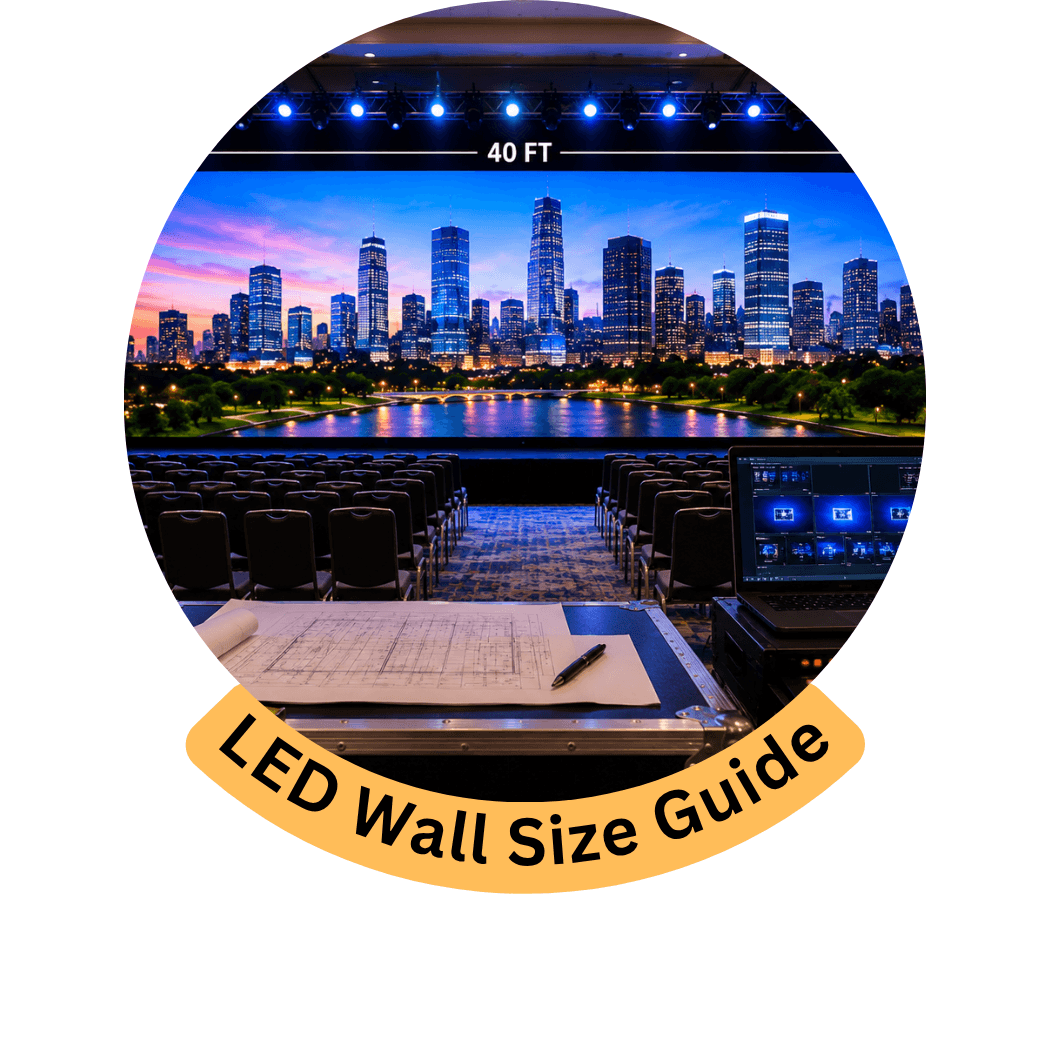
1. What Determines the Right LED Wall Size?
The correct LED wall size is determined by the relationship between audience viewing distance, audience depth, stage proportions, content, aspect ratio, and installation environment. A screen must be large enough for the intended content to remain useful without overwhelming the stage or event space.
| Factor | What We Evaluate | Technical Impact |
|---|---|---|
| Audience Size | Width and depth of audience | Influences overall display scale |
| Viewing Distance | Closest and farthest viewers | Affects size and pixel pitch |
| Stage Dimensions | Available width and height | Defines practical screen proportions |
| Content | Presentations, video, graphics, IMAG | Influences required screen area |
| Aspect Ratio | Content format and canvas | Affects width-to-height relationship |
| Sightlines | Seating and obstructions | Affects position and elevation |
| Pixel Pitch | Pixel density | Determines native resolution |
| Installation | Ground-supported or suspended | Affects practical dimensions |
| Venue Layout | Available production footprint | Limits positioning and support |
For preliminary planning, our LED Screen Size Calculator can provide an initial estimate. We verify the final dimensions against the actual event requirements.
2. How Do We Determine the Right LED Wall Size?
We determine LED wall size by working from the audience, stage, viewing distance, content, and installation environment rather than starting with a predetermined screen dimension.
We Calculate Audience Viewing Distance
We identify the closest practical viewing position and consider how deep the audience extends.
A display for a compact conference room has different sizing requirements from a screen serving attendees across a large ballroom, convention environment, outdoor event, or general session.
Our LED Viewing Distance Guide explains how audience distance affects LED planning.
We Evaluate Audience Width and Depth
Audience count alone can be misleading. Two events with the same attendance may have completely different seating layouts.
We evaluate how far attendees extend from the stage and how widely they are distributed across the room or event site.
We Measure the Available Stage Area
We determine how much width and height can practically be dedicated to the LED wall while preserving space for speakers, performers, scenic elements, lighting, cameras, and other production equipment.
The LED wall should function as part of the stage design rather than simply occupy the maximum available area.
We Review the Content
Screen dimensions should support the content being displayed.
We review requirements for:
- PowerPoint presentations
- Videos
- Camera IMAG
- Sponsor graphics
- Event branding
- Data and charts
- Multiple content windows
- Scenic graphics
Presentation-heavy events may require different screen proportions from concerts or productions dominated by IMAG.
We Determine the Aspect Ratio
We evaluate whether a standard widescreen format or a custom LED canvas better serves the production.
Because LED walls are modular, the display does not have to follow a conventional television format. However, custom dimensions require content and processing to be mapped correctly to the final canvas.
For presentation-focused events, our PowerPoint on LED Screens Guide explains how presentation format relates to the LED canvas.
We Select Pixel Pitch
After establishing the physical viewing environment, we select a pixel pitch appropriate for the closest audience position and required content detail.
Screen size and pixel pitch work together. Physical dimensions determine display area, while pixel pitch helps determine the pixel density and native resolution available within that area.
See our LED Pixel Pitch Guide for deeper technical planning.
We Determine Native Resolution
Once screen dimensions and pixel pitch are established, we calculate the resulting LED canvas resolution.
We then configure video processing and content mapping around that native canvas rather than assuming the display will automatically operate at a conventional video resolution.
We Evaluate Audience Sightlines
Screen size alone does not guarantee visibility. We evaluate display elevation, audience layout, stage height, scenic elements, cameras, and other potential obstructions.
For wide or deep audiences, supplemental screens may sometimes be more effective than making the main LED wall excessively large.
We Verify Installation Space
The final dimensions must work with the actual installation method.
We account for the display itself, support structure, rigging where applicable, cable routing, processing equipment, stage footprint, and safe production access. Our LED Screen Installation Guide covers these considerations in greater detail.
3. How Does Audience Size Affect LED Wall Size?
Audience size influences LED wall dimensions, but attendance alone is not enough to specify a screen. We also need to understand audience width, depth, seating orientation, viewing distance, and the type of content being displayed.
For example, a wide ballroom layout may require a different screen strategy from a deep theater-style seating arrangement with the same number of attendees.
We therefore evaluate audience geometry rather than using a fixed formula such as “X attendees require X-size LED wall.”
4. How Does Viewing Distance Affect LED Wall Size?
As audience distance increases, the display generally needs sufficient physical scale for important content to remain visible. However, screen dimensions and pixel pitch solve different parts of the viewing problem.
Screen size affects how large the content appears. Pixel pitch affects pixel density and image detail at closer viewing positions.
This distinction matters when configuring LED systems. Installing an extremely fine-pitch display does not compensate for a screen that is physically too small for attendees positioned far from the stage.
Likewise, making a screen larger does not automatically make a coarse pixel structure appropriate for viewers positioned very close to it.
5. How Does Stage Width Affect LED Wall Dimensions?
Stage width establishes an important practical boundary for the LED design. We position the display in relation to speakers, performers, scenic elements, lighting, cameras, entrances, and other production requirements.
Depending on the event, we may configure:
- A centered main LED wall
- A wide panoramic LED canvas
- A main wall with supplemental displays
- Separate LED sections
- A display integrated into scenic elements
We do not automatically fill the entire available stage width. The correct configuration is the one that supports the audience and content while maintaining a workable production layout.
6. How Does Content Aspect Ratio Affect LED Wall Size?
Content aspect ratio affects the relationship between LED wall width and height. Standard presentation and video formats can often be accommodated efficiently, while custom LED dimensions may require purpose-built content or processor-based mapping.
We determine whether the event needs a conventional widescreen canvas or whether a custom format provides a better production result.
For PowerPoint-heavy conferences, corporate meetings, and general sessions, establishing the canvas before final content preparation can reduce unnecessary scaling, cropping, and unused display space.
7. Should We Use One Large LED Wall or Supplemental Screens?
The right approach depends on audience width, audience depth, venue layout, stage design, sightlines, and content. A single larger LED wall works well when most attendees have a clear view of the main stage, while supplemental screens can improve visibility for wide, deep, or divided audiences.
One Main LED Wall
We typically consider one main LED wall when the audience is oriented toward a central stage and the display provides practical sightlines throughout the room.
This configuration can support:
- Presentations
- Videos
- Event branding
- Camera IMAG
- Sponsor graphics
- Scenic content
Main LED Wall With Supplemental Screens
For larger Houston conferences, general sessions, corporate events, and other deep-audience environments, supplemental displays may provide better viewing than simply increasing the main screen dimensions.
We evaluate audience geometry before determining the display layout.
8. How Does Event Type Affect LED Wall Size?
Event type affects LED wall sizing because the amount and type of information displayed changes. We configure screen dimensions around what attendees actually need to see.
| Event Type | What We Configure | Main Sizing Considerations |
|---|---|---|
| Corporate Event | Main Indoor LED Wall | Presentations, branding, audience depth |
| Conference | Main LED + possible supplemental displays | Text readability, IMAG, sightlines |
| Trade Show | Booth-scale LED configuration | Booth footprint, close viewing |
| Product Launch | Main or custom LED canvas | Product visuals, video, stage design |
| Concert | Large-format LED / IMAG displays | Audience distance, cameras, stage |
| Gala / Awards | Stage LED backdrop | Scenic design, awards, IMAG |
| Outdoor Event | Outdoor LED / Mobile LED Trailer | Audience area, daylight, positioning |
| Brand Activation | Custom LED configuration | Viewing proximity, footprint, content |
These are planning approaches rather than fixed screen sizes. We determine actual dimensions from the specific production.
9. How Do Cameras and IMAG Affect LED Wall Size?
Cameras and IMAG can change the required screen dimensions because the display becomes part of the audience’s live viewing system rather than only a presentation surface.
For larger audiences, we evaluate:
- Camera framing
- Audience depth
- Screen position
- Image size
- Stage activity
- Speaker visibility
- Number of displays
- Content and IMAG layouts
A larger physical screen can make live camera images easier to see from farther away, but screen dimensions must still work with the stage and venue.
10. What LED Wall Sizing Mistakes Do We Help Prevent?
Incorrect LED wall sizing usually results from considering one variable—such as attendance or available stage width—without evaluating the complete production environment.
Selecting Size From Audience Count Alone
Two 500-person events can have completely different seating layouts and viewing distances.
We evaluate audience width and depth rather than relying on attendance alone.
Making the Screen Too Small for Detailed Content
A physically small screen may make presentation text, charts, sponsor information, or multi-window layouts difficult to see from farther audience positions.
We review the actual content before finalizing dimensions.
Making the Screen Larger Than Necessary
An oversized wall can increase LED quantity, processing, power, structural requirements, installation labor, and rental cost without providing a meaningful production benefit.
Our LED Screen Rental Cost Guide explains how screen dimensions affect the overall rental scope.
Ignoring Pixel Pitch
Physical size and pixel density must be considered together. A large wall does not automatically provide the appropriate close-view image quality.
We verify both screen dimensions and pixel pitch.
Ignoring Stage Proportions
A display can technically fit within a room while still being poorly proportioned to the stage.
We account for presenters, scenic design, lighting, entrances, cameras, and other production elements.
Ignoring Sightlines
A correctly sized LED wall can still perform poorly if it is positioned too low or obstructed for portions of the audience.
We evaluate screen elevation and audience layout as part of sizing.
Designing Content Before Finalizing the Canvas
Custom LED dimensions can produce a non-standard native resolution. Content prepared without knowing the final canvas may require unnecessary scaling or cropping.
We establish the display configuration early enough for content teams to prepare appropriate assets.
11. Which LED Display Solution Is Right for Different Screen-Size Requirements?
Different LED products solve different sizing and deployment requirements. We select the display type after evaluating the audience, environment, content, installation method, and available footprint.
Indoor LED Wall
Indoor LED Walls provide modular sizing for conferences, corporate events, exhibitions, galas, product launches, and general sessions.
We configure the wall dimensions and pixel pitch together to achieve the required physical scale and pixel density.
Outdoor LED Wall
Outdoor LED Walls can be configured for larger audience environments where brightness, viewing distance, positioning, structural support, and weather exposure must be considered.
Our Outdoor LED Screen Guide covers the additional planning involved in outdoor configurations.
Mobile LED Trailer
A Mobile LED Trailer provides a predefined display platform rather than the same modular sizing flexibility as a conventionally built LED wall.
We evaluate whether the available trailer screen configuration is appropriate for the audience size, viewing distance, site layout, and content.
LED Poster
LED Posters are more appropriate for localized viewing applications such as registration, schedules, sponsor content, directories, and branding where a large-format wall is unnecessary.
Kinetic Video Wall
Kinetic Video Walls are selected when screen movement and creative content are part of the production design. Dimensions must account for both the display surfaces and their programmed movement.
12. Can a Larger LED Wall Compensate for a Wider Pixel Pitch?
Not completely. Increasing physical screen size and selecting pixel pitch address different technical requirements.
A larger screen increases the physical size of the image for distant viewers. Pixel pitch determines how closely individual pixels are positioned and therefore affects pixel density and close-view image detail.
We evaluate both together:
Physical dimensions → audience-scale visibility
Pixel pitch → pixel density and native resolution
For this reason, we do not solve every viewing problem simply by making the screen larger or specifying a finer pitch.
13. How Does LED Wall Height Affect Audience Visibility?
LED wall height affects both content scale and sightlines. We determine display height according to audience depth, stage dimensions, screen elevation, content layout, and potential obstructions.
A taller wall can provide more vertical display area, but increasing height is not automatically the right solution. We evaluate whether additional height improves visibility or simply adds unnecessary display area.
For seated audiences, we also consider whether attendees farther back can see the lower portion of the screen. Screen elevation and positioning can sometimes be as important as the physical dimensions.
14. How Does Pixel Pitch Affect the Resolution of a Specific LED Wall Size?
Pixel pitch determines how many pixels fit within a given physical LED wall area. For two walls with identical physical dimensions, the finer-pitch configuration will generally provide a higher native pixel count.
We evaluate:
- Physical screen dimensions
- Pixel pitch
- Cabinet/module configuration
- Native pixel dimensions
- Content resolution
- Closest viewing distance
This relationship is why we determine physical size and pixel pitch together rather than treating them as separate decisions.
Our LED Pixel Pitch Guide explains pixel density and pitch selection in greater detail.
15. Does an Outdoor LED Screen Need to Be Larger?
Not automatically. Outdoor LED screen size depends on audience distance, audience area, content, screen position, daylight conditions, and the event layout.
Outdoor audiences may be distributed across a larger or deeper viewing area than audiences inside a ballroom or meeting room. In those situations, greater physical screen dimensions may be appropriate.
However, brightness and screen size solve different problems. Increasing screen dimensions does not compensate for insufficient brightness in a high-ambient-light environment.
For outdoor Houston productions, we evaluate screen size together with positioning, brightness, weather exposure, structural support, power, and audience viewing conditions. Our Outdoor LED Screen Guide covers those requirements in more detail.
16. How Does Installation Method Limit LED Wall Size?
Installation method can place practical and structural limits on the final LED wall configuration. We determine dimensions only after considering how the display will be safely supported in the actual event environment.
Ground-Supported LED Walls
For ground-supported systems, we evaluate the display dimensions, support structure, available footprint, floor conditions, stage integration, cable routing, and surrounding production equipment.
Truss-Hung LED Walls
For suspended LED systems, the complete display and rigging configuration must be evaluated against the approved structural conditions for the specific venue and production.
Screen weight, truss, motors, rigging hardware, attachment points, structural capacity, and applicable venue requirements must be verified by qualified parties rather than assumed from universal limits.
Our Truss-Hung LED Screen Guide explains the additional planning involved with suspended LED systems.
17. How Does LED Wall Size Affect Power Requirements?
Larger LED walls generally contain more LED cabinets, so physical screen area can increase total electrical demand. However, screen dimensions alone are not sufficient to calculate LED power requirements.
We verify the actual equipment configuration, including:
- LED cabinet type and quantity
- Manufacturer electrical specifications
- Screen configuration
- Operating brightness
- Processing and control equipment
- Supporting video systems
- Available electrical service
- Required distribution
We calculate power from the equipment being deployed rather than using a universal watts-per-square-foot assumption.
Our LED Power Requirements Guide explains the power-planning process in greater detail.
18. How Does LED Wall Size Affect Rental Cost?
LED wall size is an important cost factor because larger displays generally require more LED cabinets. Increasing screen dimensions can also affect processing, structural support, power distribution, transportation, installation labor, and technical staffing.
However, size is only one pricing variable. Pixel pitch, rental duration, installation method, cameras, IMAG, processing, and supporting production equipment also affect the final system.
Our LED Screen Rental Cost Guide explains how these variables combine when we prepare a rental configuration.
19. What Information Do We Need to Determine Your LED Wall Size?
To determine the right LED wall size, we need enough information to understand the audience, viewing environment, stage, content, installation space, and production requirements. You do not need to know the final screen dimensions before requesting a quote.
| Information | Why We Need It |
|---|---|
| Venue / Event Location | Establishes the installation environment |
| Indoor or Outdoor | Helps determine display configuration |
| Audience Size | Provides initial audience scale |
| Audience Layout | Shows audience width and depth |
| Closest Viewing Distance | Helps determine pixel pitch |
| Farthest Viewing Distance | Helps evaluate physical screen scale |
| Stage Dimensions | Defines practical display space |
| Floor Plan | Helps evaluate positioning and sightlines |
| Content Type | Determines how the screen will be used |
| Aspect Ratio | Influences width-to-height proportions |
| Cameras / IMAG | Affects live-image requirements |
| Installation Method | Determines support and rigging considerations |
If these details are not yet finalized, our LED Screen Size Calculator can provide a preliminary sizing estimate.
We then verify that estimate against the actual stage dimensions, audience geometry, viewing distance, content, pixel pitch, sightlines, and installation requirements before specifying the final LED wall.
For a Houston event, you can request a quote with the venue, event date, estimated attendance, stage information, and any screen dimensions you are already considering. Our production team can determine the remaining technical requirements.