
LED Power Requirements Guide
LED screen power requirements depend on the specific LED cabinets, screen dimensions, cabinet quantity, manufacturer electrical specifications, operating configuration, processors, and supporting production equipment. There is no single wattage or circuit requirement that applies to every LED wall.
Houston LED Screen Rental uses 23+ years of event production experience to plan power as part of the complete LED system. We identify the equipment being deployed, calculate the connected load from applicable manufacturer data, review available electrical service, plan distribution, and coordinate installation and testing with qualified personnel where required. For outdoor, suspended, or large-format systems, power planning must also account for the actual site and production environment.
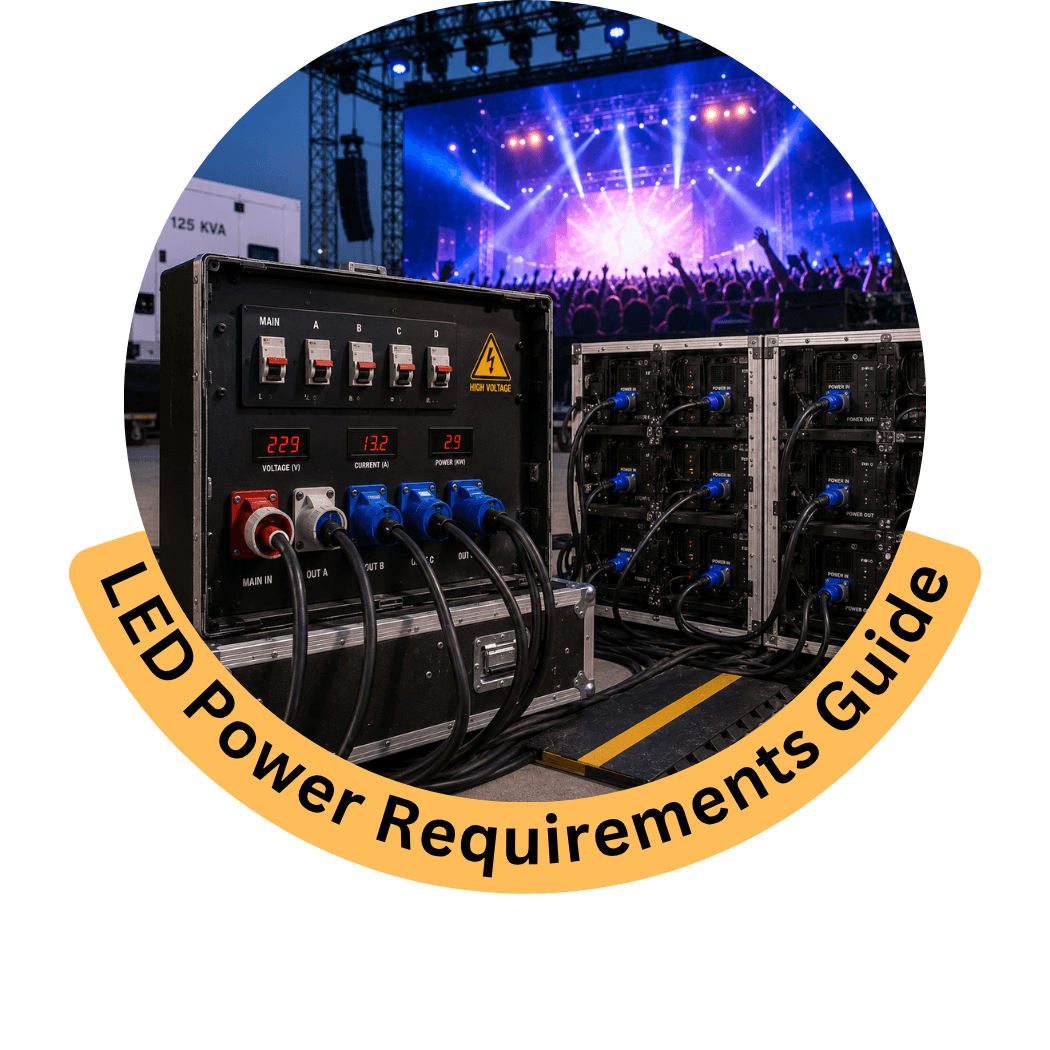
1. What Determines LED Screen Power Requirements?
LED screen power requirements are determined by the actual equipment and system configuration, not simply by screen size. We calculate requirements after identifying the LED product, cabinet quantity, electrical specifications, processors, control equipment, and supporting production loads.
| Factor | What We Evaluate | Technical Impact |
|---|---|---|
| LED Product | Manufacturer electrical data | Establishes equipment requirements |
| Screen Dimensions | Width and height | Influences cabinet quantity |
| Cabinet Quantity | Total LED cabinets | Affects connected display load |
| Operating Configuration | System-specific operation | Influences actual demand |
| Video Processing | Processor and control equipment | Adds supporting load |
| Cameras / IMAG | Camera and video systems | Adds production power |
| Audio / Lighting | Separate production systems | Requires coordinated distribution |
| Available Service | Venue/site electrical supply | Determines distribution planning |
| Installation Location | Indoor or outdoor environment | Affects deployment requirements |
| Cable Routing | Distribution path | Affects power-layout planning |
We do not publish a universal watts-per-square-foot figure because electrical characteristics vary between LED products and configurations.
2. How Do We Calculate LED Screen Power Requirements?
We calculate LED screen power requirements from the specific equipment scheduled for the production. We then compare those requirements with the available electrical service and design an appropriate distribution plan.
We Identify the LED Product
Power planning starts with the actual LED equipment.
Different cabinet models can have different:
- Electrical specifications
- Cabinet dimensions
- Power connections
- Maximum loads
- Typical operating characteristics
- Manufacturer requirements
We therefore do not estimate final electrical demand from pixel pitch or screen dimensions alone.
We Determine the Cabinet Quantity
Once the LED wall dimensions are established, we determine how many cabinets are required to construct the display.
A larger screen generally requires more cabinets and therefore can increase the total electrical requirement.
Our LED Wall Size Guide explains how we determine appropriate physical screen dimensions.
We Review Manufacturer Electrical Data
We use applicable manufacturer specifications for the equipment being deployed.
This allows us to calculate the display load from verified product information rather than generic assumptions.
We Calculate the Complete LED Load
We calculate the requirements of the configured LED display based on the cabinet quantity and applicable electrical data.
Where specifications distinguish between different operating-load values, we use the appropriate values for the engineering and distribution decision being made rather than treating one number as universally applicable.
We Include Processing and Control Equipment
The LED cabinets are not the entire video system.
We also account for relevant equipment such as:
- LED processors
- Control systems
- Presentation switching
- Video switching
- Media servers
- Playback systems
- Production computers
- Signal-conversion equipment
These loads are included in the broader production-power plan.
We Include Cameras and IMAG Systems
If the event uses cameras and IMAG, we account for camera equipment, switching, monitoring, communications, and related video systems where applicable.
We Review Available Electrical Service
We compare the calculated system requirements with the electrical service available at the venue or event site.
We verify the applicable voltage, circuits, distribution arrangement, connection points, and other relevant electrical conditions rather than assuming every Houston venue provides the same infrastructure.
We Plan Distribution
Once the load and available service are understood, the appropriate qualified personnel can establish how power will be distributed to the LED system.
Distribution planning can involve:
- Appropriate circuits
- Distribution equipment
- Cable routing
- Connection locations
- Load allocation
- Equipment positioning
- Separation of production systems where required
The exact configuration depends on the equipment and site.
We Test Before Operation
After installation, the LED and supporting systems are tested under the planned production configuration before live operation.
3. Can LED Wall Power Be Calculated From Screen Size Alone?
No. Screen size alone is not enough to calculate LED wall power accurately. Physical dimensions can help determine cabinet quantity, but the electrical requirement depends on the specifications of those cabinets and the complete system.
Two LED walls with identical dimensions can use different products with different electrical characteristics.
We therefore calculate:
screen configuration → cabinet quantity → equipment electrical data → system requirement
rather than applying one universal power figure to every square foot of LED.
If the screen dimensions are still being established, our LED Screen Size Calculator can provide a preliminary sizing estimate before equipment-specific power calculations are completed.
4. Does a Larger LED Wall Require More Power?
Generally, increasing LED wall dimensions increases cabinet quantity, which can increase the total electrical requirement. However, the exact change depends on the LED product being used.
Screen size can also indirectly affect power requirements by increasing the amount of supporting equipment needed for the production.
A larger configuration may involve additional:
- LED cabinets
- Data distribution
- Processing
- Support equipment
- Cameras
- Production control
- Supplemental displays
We calculate the final requirement only after the complete equipment configuration has been established.
5. Does Pixel Pitch Affect LED Screen Power Requirements?
Pixel pitch alone does not determine electrical demand. A finer or wider pitch identifies pixel spacing, but actual power requirements depend on the specific LED product and its manufacturer specifications.
When comparing LED configurations, we evaluate:
- Pixel pitch
- Cabinet design
- Physical cabinet dimensions
- Cabinet quantity
- Electrical specifications
- Screen dimensions
- Operating configuration
Two products with similar pixel pitches should not be assumed to have identical electrical requirements.
Our LED Pixel Pitch Guide explains why pixel pitch should be selected primarily around viewing distance, pixel density, content, and resolution requirements.
6. What Is the Difference Between Maximum and Typical LED Power?
LED manufacturers may provide different electrical figures for their equipment, such as maximum and typical or average consumption. These figures describe different operating conditions and should not be treated as interchangeable.
For production planning, we review the applicable manufacturer documentation and determine which values are appropriate for:
- Electrical service planning
- Distribution design
- Operational estimates
- Equipment configuration
We do not reduce required electrical capacity simply because expected operating consumption may be lower than a specified maximum value.
The electrical design must follow the requirements of the actual equipment, installation, and applicable qualified electrical planning.
7. How Does LED Brightness Affect Power Consumption?
LED operating conditions, including brightness, can influence actual power consumption, but the relationship depends on the specific display technology and configuration.
For this reason, we do not calculate required electrical infrastructure by assuming the screen will always operate at a reduced brightness level.
Indoor and outdoor displays may also operate under very different ambient-light conditions. Outdoor systems can require greater display brightness for daylight visibility, but electrical requirements still need to be derived from the actual equipment specifications.
Our Outdoor LED Screen Guide explains how brightness, daylight, screen positioning, and environmental conditions are evaluated for outdoor events.
8. How Do Indoor and Outdoor LED Power Requirements Differ?
Indoor and outdoor LED systems can have different electrical requirements because the equipment, operating environment, brightness requirements, screen dimensions, and installation configuration may differ.
We calculate each system from the actual equipment rather than assuming that all outdoor LED walls require a fixed amount more power than indoor systems.
| Requirement | Indoor LED Wall | Outdoor LED Wall |
|---|---|---|
| Equipment | Indoor-rated LED product | Appropriate outdoor LED product |
| Brightness | Based on indoor ambient light | Based on outdoor viewing conditions |
| Screen Scale | Venue and audience dependent | Site and audience dependent |
| Electrical Load | Equipment specific | Equipment specific |
| Distribution | Venue-specific | Site-specific |
| Environment | Controlled indoor conditions | Environmental exposure considered |
| Power Planning | Verified from equipment | Verified from equipment and site |
Outdoor electrical systems also require planning appropriate to the environment and applicable installation requirements.
9. How Do We Plan Power Distribution for an LED Wall?
We plan LED power distribution after calculating the requirements of the complete display system and verifying the available electrical service. The objective is to distribute the required load appropriately across the system rather than treating the LED wall as a single generic electrical device.
We Determine the Complete Equipment Load
We identify the LED cabinets, processors, control equipment, and other systems that require power.
We Verify Available Electrical Service
We review the service available for the production rather than assuming that suitable connections are automatically available near the screen.
We Determine Distribution Requirements
The electrical distribution must be appropriate for the equipment, calculated load, installation, and available service.
We Plan Cable Routing
Power cable routes are coordinated with the LED wall, stage, audience areas, video signal paths, and other production systems.
We Coordinate With Qualified Personnel
Electrical connections, distribution, and related work must be performed or verified by appropriately qualified personnel where required.
10. Do Video Processors and Media Servers Require Separate Power Planning?
Yes. Video processors, media servers, presentation computers, switching systems, playback equipment, and related control systems are part of the overall production-power requirement.
Their loads may be much smaller than a large LED wall, but they are operationally critical.
We account for relevant equipment such as:
- LED processors
- Video switchers
- Presentation switchers
- Media servers
- Playback computers
- Control computers
- Monitors
- Signal converters
- Networking equipment
We also consider where this equipment will physically operate, such as front-of-house, backstage, or another production-control location.
11. How Do Cameras and IMAG Affect Event Power Requirements?
Cameras and IMAG add equipment beyond the LED wall itself. Depending on the production, this can include cameras, switching, monitoring, signal distribution, communications, and production-control equipment.
We coordinate these loads with the broader event-power plan.
For large Houston conferences, corporate events, graduations, concerts, and other productions using IMAG, we evaluate the complete video system rather than calculating only the LED display.
12. How Does Installation Method Affect LED Power Distribution?
Installation method affects where equipment is positioned, how power reaches the display, cable-routing requirements, and how the electrical system integrates with the overall production.
Ground-Supported LED Walls
For ground-supported displays, we coordinate distribution around the screen structure, stage, processing equipment, and available electrical locations.
Truss-Hung LED Walls
For suspended LED walls, power and data routing must be coordinated with the approved rigging and display configuration.
Electrical cabling must not be planned independently from the physical installation.
Our Truss-Hung LED Screen Guide explains the additional planning required for suspended LED systems.
Mobile LED Trailers
Mobile LED Trailer power requirements depend on the specific trailer system and supporting production equipment.
We verify the actual equipment configuration and site requirements rather than assuming every trailer has the same electrical arrangement.
13. How Do We Plan Power for Outdoor LED Screens?
Outdoor LED power planning requires us to consider both electrical demand and the installation environment. We verify the specific outdoor LED equipment, distribution requirements, site electrical service, cable routing, and environmental conditions.
We evaluate:
- LED equipment specifications
- Cabinet quantity
- Available electrical service
- Distribution equipment
- Connection locations
- Cable routing
- Weather exposure
- Supporting production equipment
- Installation layout
Outdoor electrical equipment and connections must be appropriate for the intended environment and applicable requirements.
We do not assume that equipment is suitable for outdoor use simply because it can physically be positioned outside.
14. Can a Generator Power an LED Wall?
Potentially, but generator selection must be based on the calculated electrical requirements of the complete production system and the characteristics of the equipment being powered. We do not recommend a generator capacity from LED wall dimensions alone.
Before a generator-supported configuration is finalized, qualified personnel need to evaluate factors such as:
- Calculated connected loads
- LED equipment requirements
- Supporting AV loads
- Distribution
- Voltage requirements
- Connection requirements
- Generator characteristics
- Cable routing
- Applicable grounding/bonding requirements
- Operational requirements
The generator and distribution system must be properly specified for the actual production.
15. How Does Event Type Affect LED Power Planning?
Event type can change the complete equipment package and therefore the overall electrical scope.
| Event Type | Typical Video Requirements | Power Planning Focus |
|---|---|---|
| Corporate Event | LED + presentations | Display and control systems |
| Conference | LED + switching + IMAG | Complete video workflow |
| Trade Show | LED booth display | Available booth electrical service |
| Product Launch | LED + playback + cameras | Multi-source production |
| Concert | Large LED + cameras | Display scale and production systems |
| Gala / Awards | LED + IMAG + graphics | Stage and video equipment |
| Outdoor Event | Outdoor LED system | Site service and environment |
| Brand Activation | Custom display configuration | Footprint and equipment requirements |
These are production examples rather than fixed electrical specifications. We calculate requirements from the actual equipment selected for each event.
16. What LED Power Planning Mistakes Do We Help Prevent?
LED power problems often result from estimating electrical requirements before the final equipment configuration is known.
Calculating Power From Screen Size Alone
Physical dimensions do not identify the exact electrical characteristics of the LED product.
We determine cabinet quantity and use applicable equipment data.
Using Average Consumption as the Only Planning Figure
Expected operating consumption should not automatically be treated as the required electrical capacity.
We use the appropriate manufacturer specifications for the planning decision.
Ignoring Supporting Video Equipment
Processors, switchers, media servers, computers, cameras, monitors, and other equipment also require power.
We include relevant supporting systems in the production plan.
Assuming Venue Power Is Sufficient
The presence of electrical service does not establish that it is suitable for the proposed LED configuration.
We verify available service against the actual system requirements.
Planning Power After Installation Design
Power connection locations and cable routes can affect the physical production layout.
We coordinate electrical planning with the LED installation rather than treating it as a last-stage requirement.
Assuming Similar LED Products Have the Same Load
Cabinets with similar dimensions or pixel pitches can have different electrical specifications.
We verify the actual product being deployed.
Treating Outdoor Power Like Indoor Power
Outdoor environments introduce additional equipment and installation considerations.
We plan the electrical system for the actual environment.
17. Does LED Power Requirement Affect Rental Cost?
It can. Power requirements may affect the distribution equipment, cabling, electrical coordination, installation labor, and supporting infrastructure required for the production.
However, power is only one component of LED rental pricing. Screen dimensions, pixel pitch, installation method, processing, cameras, rental duration, transportation, and technical staffing can also affect the overall scope.
Our LED Screen Rental Cost Guide explains these pricing factors in greater detail.
18. How Do We Separate LED Power From Other Event Production Loads?
We plan LED power as part of the complete production system while identifying the requirements of other equipment separately. Audio, lighting, cameras, video control, media servers, and other systems can all contribute to the event’s total electrical demand.
Depending on the production, we coordinate requirements for:
- LED walls
- Video processors
- Presentation switching
- Media servers
- Cameras and IMAG
- Playback systems
- Professional audio
- Event lighting
- Control equipment
- Supporting production systems
The final distribution plan depends on the actual equipment, available electrical service, and site requirements.
19. How Does Cable Distance Affect LED Power Distribution?
Cable routing and distance are important parts of electrical planning. Longer distribution paths can affect cable selection, routing, connection locations, and overall system design.
We determine where power is available in relation to:
- LED wall position
- Stage
- Ground-support or rigging system
- Video control
- Equipment racks
- Camera positions
- Other production systems
Electrical conductors and distribution equipment must be appropriately specified for the actual load, distance, installation, and applicable requirements. We do not use one universal cable size or distance limit for every LED installation.
20. How Do We Plan Power for Multiple LED Walls?
Multiple LED walls require us to calculate the electrical requirements of each display and then evaluate the combined production load.
For example, an event may use:
- Main stage LED wall
- Side LED displays
- Supplemental audience screens
- Exhibition displays
- LED Posters
- Additional scenic LED elements
We determine the cabinet quantities and equipment requirements for each system before coordinating the complete distribution plan.
Multiple displays can also require additional processing and signal-distribution equipment, which we include in the overall production requirements.
21. How Does LED Wall Size Affect Electrical Distribution?
As LED wall dimensions increase, the number of cabinets generally increases. This can increase both the total electrical demand and the complexity of distributing power across the display.
However, we do not determine electrical distribution from physical size alone.
We first establish the screen dimensions, then identify the exact LED configuration and calculate requirements from the applicable equipment specifications.
For projects where dimensions are still being determined, our LED Screen Size Calculator can provide a preliminary screen-size estimate.
22. How Do We Coordinate Power With LED Screen Installation?
Power and installation are planned together because the screen position and support method affect where electrical connections, distribution equipment, and cables can be located.
We coordinate:
Screen Position
We determine where the LED wall will be installed relative to available electrical service.
Support System
Ground-supported and suspended configurations can require different cable-routing approaches.
Power Distribution
Distribution equipment is positioned according to the system design, installation environment, and qualified electrical planning.
Signal Distribution
Power and video/data routing are planned together while maintaining the requirements appropriate to each system.
Production Access
Cable paths and equipment positions must work with stage operations, audience areas, load-in, technical access, and other production requirements.
Our LED Screen Installation Guide explains how these requirements fit into the complete installation workflow.
23. What Do We Check During LED Power Testing?
Before live operation, we verify that the LED system and supporting equipment are operating within the planned production configuration.
Relevant checks can include:
| System | What We Verify |
|---|---|
| LED Cabinets | Complete display operation |
| Distribution | Planned equipment connections |
| Processing | Processor and control operation |
| Signal System | Stable source-to-display workflow |
| Supporting Video | Switching, playback and control |
| Cameras / IMAG | Required production systems |
| Cable Routing | Final installed configuration |
| Complete System | Operation before show time |
The specific electrical testing and verification procedures depend on the equipment, installation, and applicable requirements and should be performed by qualified personnel where required.
24. What Do We Verify Before Finalizing LED Power Distribution?
Before finalizing LED power distribution, we verify the actual LED equipment, total system configuration, available electrical service, installation environment, and supporting production requirements.
| Information | What We Determine |
|---|---|
| LED Product | Applicable electrical specifications |
| Screen Dimensions | Required cabinet configuration |
| Cabinet Quantity | Total display equipment |
| Manufacturer Data | Equipment-specific electrical requirements |
| Operating Configuration | Relevant system demand |
| Processors | Supporting video load |
| Cameras / IMAG | Additional production equipment |
| Other AV Systems | Overall production coordination |
| Available Service | Site electrical capability |
| Installation Method | Distribution and routing requirements |
| Cable Paths | Practical power routing |
| Indoor / Outdoor | Environmental requirements |
| Event Schedule | Installation, testing and operation |
If the final screen dimensions are not yet established, we first determine the appropriate display size from the audience, viewing distance, stage, and content requirements. Our LED Wall Size Guide explains that process.
For suspended installations, power and data routing must also coordinate with the approved support configuration. See our Truss-Hung LED Screen Guide for additional planning considerations.
You do not need to calculate electrical requirements yourself before requesting an LED screen rental. For a Houston event, provide the venue or event site, screen requirement if known, event date, indoor or outdoor environment, and supporting AV requirements. Our production team can determine the equipment configuration and coordinate the remaining power-planning requirements with qualified personnel as applicable.