
LED Pixel Pitch Guide
LED pixel pitch is the distance between adjacent pixels on an LED display and is a key factor in pixel density, native resolution, and close-view image quality. A smaller pixel pitch places pixels closer together, but the smallest available pitch is not automatically the right choice for every event.
Houston LED Screen Rental uses 23+ years of event production experience to select pixel pitch around the actual viewing environment. We evaluate viewing distance, LED wall dimensions, content detail, audience layout, cameras, and required resolution before configuring the display. Pixel pitch should be selected as part of the complete LED system—not as an isolated specification.
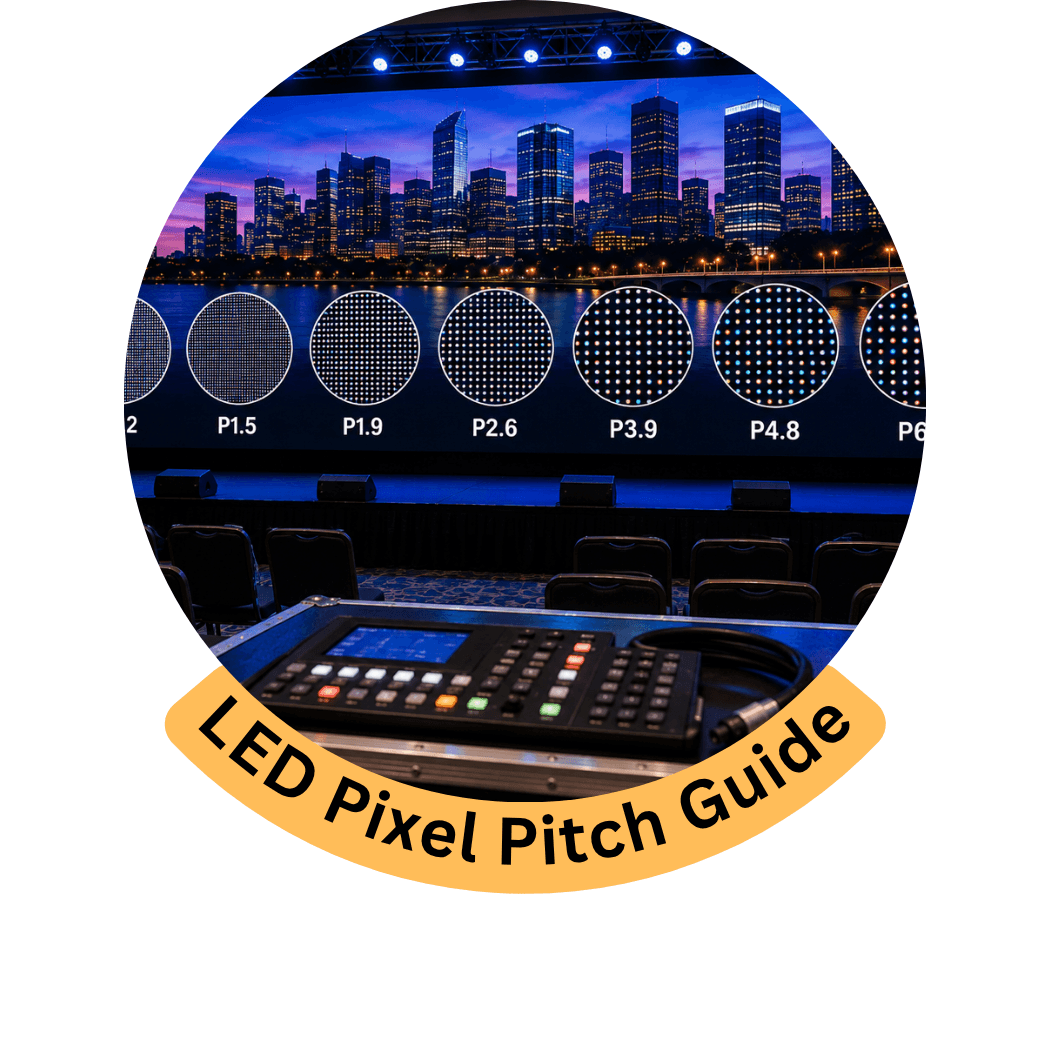
1. What Does LED Pixel Pitch Actually Measure?
LED pixel pitch measures the center-to-center distance between neighboring pixels, typically expressed in millimeters. It determines how densely pixels are arranged across the physical LED display.
A smaller pitch generally creates greater pixel density within the same physical area. A wider pitch places fewer pixels within that same area.
| Factor | What We Evaluate | Technical Impact |
|---|---|---|
| Pixel Pitch | Spacing between pixels | Determines pixel density |
| Viewing Distance | Closest practical viewer | Influences pitch selection |
| Screen Dimensions | Physical width and height | Works with pitch to determine resolution |
| Content | Text, video, graphics, IMAG | Determines detail requirements |
| Native Resolution | Total LED canvas pixels | Affects content mapping |
| Audience Layout | Near and far viewers | Influences overall configuration |
| Cameras | IMAG and playback requirements | Affects content workflow |
| Environment | Indoor or outdoor use | Influences display selection |
We do not choose pixel pitch from the pitch number alone. The correct selection depends on how the complete display will be used.
2. How Do We Select the Right LED Pixel Pitch?
We select LED pixel pitch by evaluating the closest viewing distance, screen dimensions, content detail, native resolution requirements, audience layout, and event environment.
We Calculate the Closest Viewing Distance
The closest practical audience position is one of the most important factors.
As viewers move closer to an LED wall, pixel structure becomes more relevant. A finer pitch can provide greater pixel density for close-view environments.
Our LED Viewing Distance Guide explains how we evaluate near and far audience positions.
We Determine Physical Screen Dimensions
Pixel pitch and screen size must be evaluated together.
The same pixel pitch used across two different physical wall sizes produces different total canvas resolutions because the larger wall contains more LED display area.
We therefore establish practical screen dimensions around the stage, audience, and content before finalizing the complete configuration.
Our LED Wall Size Guide covers the sizing process in greater detail.
We Review Content Detail
Detailed content can place greater demands on pixel density than large-format visual content.
We evaluate requirements for:
- PowerPoint text
- Charts and graphs
- Product details
- Data
- Sponsor graphics
- Video
- Camera IMAG
- Multi-window layouts
- Event branding
A corporate presentation viewed relatively close to the display can require a different pitch from a large outdoor screen primarily showing IMAG.
We Determine Native Resolution
Once the physical LED dimensions and pixel pitch are known, we determine the resulting native LED canvas.
In simplified terms:
physical dimensions + pixel pitch → native LED resolution
We then configure video processing and content around that actual canvas.
We Evaluate Audience Distribution
The closest viewer helps inform pixel-pitch selection, while farther audience positions influence physical screen scale.
These should not be confused.
A finer pitch does not make a physically small screen easier to see from the back of a large venue.
We Review Camera and IMAG Requirements
For events using cameras, we evaluate how IMAG, presentations, graphics, and other sources will share the LED canvas.
The required screen resolution depends on the physical wall, pitch, content layout, and production workflow—not simply the incoming camera resolution.
We Verify the Actual LED Product
Different LED products can have different cabinet dimensions, module designs, processing requirements, brightness characteristics, and operating specifications.
We verify the equipment being proposed rather than assuming all displays with a similar nominal pitch are technically identical.
3. How Does Viewing Distance Affect LED Pixel Pitch?
Viewing distance is one of the primary factors in pixel-pitch selection. Closer viewers generally benefit more from finer pixel density, while audiences positioned farther away may not require the same pitch.
However, we do not apply one universal pitch-to-distance formula to every event.
We also consider:
- Content detail
- Screen dimensions
- LED product
- Native resolution
- Audience expectations
- Camera requirements
- Installation environment
A simple distance formula can be useful for preliminary planning, but final pitch selection should reflect the complete production requirement.
4. Does a Smaller Pixel Pitch Always Look Better?
No. A smaller pixel pitch provides greater pixel density within the same physical screen area, but that does not mean it provides a meaningful advantage for every audience or application.
For example, if viewers are positioned relatively far from a large LED wall, moving to a significantly finer pitch may add pixel density that the production does not practically require.
We select the pitch that supports the actual:
viewing distance + screen dimensions + content + resolution requirement
rather than automatically specifying the smallest pitch available.
This can also prevent unnecessary equipment complexity and rental cost. Our LED Screen Rental Cost Guide explains how display specifications influence the overall rental configuration.
5. How Does Pixel Pitch Affect LED Wall Resolution?
Pixel pitch directly affects the number of pixels available within a given physical LED wall area. When two walls have identical physical dimensions, the finer-pitch wall generally contains more pixels and therefore provides a higher native resolution.
For example, the relationship can be understood conceptually as:
smaller pixel spacing → more pixels across the same physical width and height
But we do not invent a resolution based only on a nominal pitch. We calculate the actual LED canvas from the specific cabinet or module configuration being deployed.
This matters because the final canvas determines how we configure:
- Video processors
- Presentations
- Graphics
- Playback
- Cameras
- IMAG
- Media servers
6. What Pixel Pitch Works for Detailed PowerPoint Content?
There is no single pixel pitch that is correct for every PowerPoint presentation. We select the pitch from the viewing distance, screen dimensions, presentation detail, text size, and required native canvas.
Detailed corporate presentations may include small text, charts, diagrams, numbers, and multiple content elements. In close-view environments, greater pixel density can help preserve detail.
However, presentation design still matters. A very fine-pitch LED wall cannot make poorly designed slides with excessively small text readable to an audience positioned far away.
Our PowerPoint on LED Screens Guide explains how we coordinate slide design, aspect ratio, resolution, processing, and the final LED canvas.
7. How Does Pixel Pitch Affect Camera IMAG?
Pixel pitch affects the pixel density available for displaying camera IMAG, but the quality and usefulness of IMAG also depend on physical screen dimensions, camera framing, processing, content layout, and audience distance.
For large audiences, physical image scale is particularly important. A high-resolution LED wall will not provide useful IMAG for distant attendees if the live camera image occupies only a small portion of the display.
We therefore coordinate:
- LED wall dimensions
- Pixel pitch
- Native canvas
- Camera framing
- IMAG window size
- Processing
- Audience viewing distance
as part of one production workflow.
8. How Does Event Type Affect LED Pixel Pitch?
Event type affects pixel-pitch selection because viewing distance, content detail, screen dimensions, and audience layout vary between productions. We select pitch according to the actual viewing environment rather than assigning one specification to each event category.
| Event Type | What We Evaluate | Main Pixel-Pitch Consideration |
|---|---|---|
| Corporate Event | Presentations, audience distance | Text and graphic detail |
| Conference | Presentations, IMAG, seating | Close-view readability |
| Trade Show | Close booth traffic | Higher pixel density where required |
| Product Launch | Product visuals, stage, cameras | Detail and content quality |
| Gala / Awards | IMAG, graphics, audience layout | Balanced viewing conditions |
| Concert | Large audience, IMAG | Distance and physical screen scale |
| Outdoor Event | Audience depth, screen size | Practical pitch for viewing range |
| Brand Activation | Close viewing, detailed content | Pixel density and visual detail |
These are planning considerations rather than fixed pixel-pitch specifications.
9. How Do We Select Pixel Pitch for Corporate Events and Conferences?
For corporate events and conferences, we prioritize presentation readability, closest viewing distance, screen dimensions, and native resolution. These productions frequently contain detailed PowerPoint slides, charts, speaker information, videos, and camera IMAG.
We evaluate whether the selected pitch provides enough pixel density for the intended content without specifying unnecessary resolution.
For deep audiences, we separately evaluate physical screen dimensions. A finer pixel pitch cannot compensate for a screen that is physically too small for attendees farther from the stage.
10. How Do We Select Pixel Pitch for Trade Shows and Exhibitions?
Trade show LED walls are often viewed from relatively short distances, so pixel density can become particularly important. We evaluate booth dimensions, attendee traffic, screen position, content detail, and the closest practical viewing position.
Fine-pitch Indoor LED Walls may be appropriate for applications involving:
- Product demonstrations
- Detailed graphics
- Technical information
- Branded video
- Presentation content
- Close-view visual experiences
However, we still select pitch from the actual booth configuration rather than automatically specifying the finest available option.
11. How Do We Select Pixel Pitch for Large-Audience Events?
For concerts, graduations, sporting events, festivals, and other large-audience productions, we evaluate pixel pitch together with physical screen dimensions and audience distance.
Farther viewing positions may reduce the practical benefit of extremely fine pixel density. At the same time, the physical display must be large enough for distant attendees to see the content.
We therefore separate two decisions:
Pixel pitch → close-view detail and pixel density
Screen dimensions → physical image scale for distant viewers
Our LED Wall Size Guide explains how we determine the physical display dimensions.
12. How Do We Select Pixel Pitch for Outdoor LED Screens?
Outdoor pixel-pitch selection depends on viewing distance, physical screen size, content, and the specific outdoor LED equipment available for the production.
Outdoor audiences are often positioned farther from the display than attendees at indoor corporate events. In those environments, an extremely fine pitch may provide limited practical benefit.
Pixel pitch is only one part of outdoor display selection. We separately evaluate:
- Brightness
- Daylight exposure
- Weather suitability
- Screen dimensions
- Structural support
- Installation method
- Power
- Audience position
Our Outdoor LED Screen Guide covers these requirements in greater detail.
13. What LED Pixel Pitch Selection Mistakes Do We Help Prevent?
Pixel-pitch mistakes usually occur when the pitch number is treated as the only measure of LED display quality. We evaluate pitch as part of the complete display configuration.
Choosing the Smallest Pixel Pitch Automatically
Smaller pitch means greater pixel density, but that additional density may not provide a practical benefit at longer viewing distances.
We select pitch according to actual audience and content requirements.
Using a Universal Viewing-Distance Formula
Simple pitch-to-distance formulas can be useful for preliminary estimates, but they do not account for screen dimensions, content, product characteristics, or required image quality.
We verify pitch against the actual production.
Ignoring Physical Screen Size
A fine-pitch screen can provide high pixel density while still being physically too small for a distant audience.
We determine screen dimensions separately.
Ignoring Native Resolution
Pixel pitch and physical dimensions determine the LED canvas. Selecting pitch without considering the resulting resolution can create unnecessary processing or content challenges.
Ignoring Content Detail
Large-format video, detailed PowerPoint presentations, camera IMAG, and technical graphics do not necessarily require the same pixel density.
We review the content before specifying the display.
Assuming All Similar-Pitch LED Products Are Identical
Two products with similar nominal pixel pitch can differ in cabinet design, processing, brightness, physical dimensions, and other manufacturer specifications.
We verify the actual equipment being deployed.
14. Which LED Display Solutions Have Different Pixel-Pitch Requirements?
Different LED applications can require different approaches to pixel density because their viewing environments and content requirements vary.
Indoor LED Wall
Indoor LED Walls are commonly used for conferences, corporate events, exhibitions, product launches, and galas where attendees may be relatively close to the display.
We select pitch around viewing distance, screen dimensions, and content detail.
Outdoor LED Wall
Outdoor LED Walls often serve larger viewing areas. We balance pitch with screen dimensions and audience distance while separately evaluating brightness and environmental requirements.
Mobile LED Trailer
Mobile LED Trailers use the display configuration integrated into the specific trailer system. We verify whether its screen dimensions and pixel pitch are appropriate for the intended audience and content.
Kinetic Video Wall
For Kinetic Video Walls, pitch selection is only one part of the design. We also evaluate screen movement, viewing distance, mapped content, media-server requirements, and the overall visual composition.
LED Poster
LED Posters typically serve localized viewing areas. We verify the specific display resolution and viewing conditions against the text, graphics, branding, or information being shown.
15. Does Finer Pixel Pitch Increase LED Screen Rental Cost?
It can. Finer-pitch LED equipment can change the rental configuration and may affect cost, but pixel pitch is only one pricing factor.
The complete rental scope can also depend on:
- Physical screen dimensions
- LED product
- Installation method
- Rental duration
- Processing
- Cameras and IMAG
- Power requirements
- Transportation
- Technical crew
We therefore do not recommend finer pitch simply because it represents a higher pixel density. We select the configuration that meets the actual production requirement.
Our LED Screen Rental Cost Guide explains how these variables contribute to overall rental pricing.
16. How Does Pixel Pitch Affect Native LED Resolution?
Pixel pitch directly affects the number of pixels available within a specific physical LED wall area. For the same physical dimensions, a finer-pitch display generally produces a higher native pixel count than a wider-pitch display.
We determine native resolution from the actual cabinet configuration and pixel pitch rather than assuming a standard video resolution.
We then use that native canvas to configure:
- Video processing
- Presentation scaling
- Graphics
- Video playback
- Camera IMAG
- Media-server content
- Multi-window layouts
This allows content to be mapped correctly to the physical LED display.
17. Can Pixel Pitch Compensate for an LED Wall That Is Too Small?
No. A finer pixel pitch increases pixel density, but it does not increase the physical size of the image for distant viewers.
These are separate technical decisions:
Pixel pitch → controls pixel density
LED wall dimensions → control physical image scale
For example, a fine-pitch wall may display detailed content clearly for nearby attendees but still be physically too small for people at the back of a large event space.
We therefore determine physical screen dimensions from audience scale, stage dimensions, and viewing distance before finalizing pitch.
For preliminary sizing, our LED Screen Size Calculator can help estimate an appropriate display size.
18. How Does Pixel Pitch Affect Content Mapping?
Pixel pitch affects the native pixel dimensions of the LED canvas, which determines how presentations, graphics, videos, and camera sources should be mapped to the display.
Once we know the final screen dimensions and cabinet configuration, we establish the native LED canvas and configure the processor accordingly.
For non-standard LED wall dimensions, the canvas may not match a conventional display format. We can then position, scale, or map content according to the production design.
This is particularly important for:
- Ultra-wide LED walls
- Custom aspect ratios
- Multi-screen configurations
- Presentation layouts
- Scenic LED designs
- Kinetic configurations
- Multi-window content
19. Does Pixel Pitch Affect LED Screen Installation?
Pixel pitch itself does not determine the installation method, but the specific LED product associated with that pitch can affect cabinet dimensions, quantity, weight, cabling, processing, and system configuration.
Installation planning therefore uses the actual LED equipment rather than the nominal pitch alone.
We evaluate:
- Cabinet dimensions
- Cabinet quantity
- Complete display dimensions
- Manufacturer specifications
- Ground-support requirements
- Rigging requirements where applicable
- Power distribution
- Data distribution
- Access and installation schedule
Our LED Screen Installation Guide explains how we plan the complete display installation.
20. Does Pixel Pitch Affect LED Screen Power Requirements?
Pixel pitch alone is not enough to calculate LED screen power requirements. Electrical demand depends on the actual LED cabinet, manufacturer specifications, cabinet quantity, display configuration, brightness settings, and supporting equipment.
Two LED products with similar pixel pitches should not be assumed to have identical electrical requirements.
We calculate power from the equipment being deployed and verify:
| Power Factor | What We Verify |
|---|---|
| LED Product | Actual equipment specifications |
| Cabinet Quantity | Complete display configuration |
| Manufacturer Data | Applicable electrical requirements |
| Operating Configuration | System-specific requirements |
| Video Equipment | Processors and control systems |
| Available Service | Site electrical availability |
| Distribution | Required power routing |
Our LED Power Requirements Guide covers this process in greater detail.
21. How Do We Compare Two Pixel-Pitch Options?
We compare pixel-pitch options using the complete viewing and production requirement rather than deciding that the smaller number is automatically better.
We evaluate each option against:
Viewing Distance
Can the proposed pitch provide the required visual result from the closest practical audience position?
Physical Screen Size
What native resolution does each pitch produce at the required wall dimensions?
Content
Does the event involve detailed presentations, charts, graphics, IMAG, video, or primarily large-format visual content?
Audience Layout
How close are the nearest viewers, and how far does the audience extend?
Processing
What LED canvas will each configuration create, and how will content be mapped to it?
Production Scope
Does the finer-pitch option provide a meaningful production benefit for the actual event?
This comparison helps us avoid specifying additional pixel density that the audience or content does not require.
22. What Do We Verify Before Selecting Your LED Pixel Pitch?
Before finalizing LED pixel pitch, we verify the information needed to balance pixel density, native resolution, physical screen dimensions, content detail, and audience viewing conditions.
| Information | What We Determine |
|---|---|
| Closest Viewing Distance | Required close-view image quality |
| Audience Depth | Overall screen-scale requirement |
| Screen Dimensions | Physical LED canvas size |
| Content Type | Required level of visual detail |
| PowerPoint Content | Text and data requirements |
| Cameras / IMAG | Live-image requirements |
| LED Product | Available cabinet configuration |
| Pixel Pitch | Pixel density |
| Native Resolution | Final LED canvas |
| Aspect Ratio | Content mapping requirements |
| Indoor / Outdoor | Appropriate display category |
| Installation | Practical system configuration |
You do not need to select a pixel pitch before requesting an LED screen rental. Provide your Houston event location, audience size, approximate viewing distance, stage dimensions, and content requirements, and our production team can evaluate the appropriate configuration.
We select pixel pitch, screen dimensions, native resolution, processing, and content mapping together rather than choosing pitch as an isolated specification.
For events where screen size is still being determined, our LED Screen Size Calculator can provide a preliminary sizing estimate before we verify the complete LED configuration.