
LED Screen Installation Guide
A professional LED screen installation requires more than assembling LED cabinets. We plan the complete system around screen dimensions, installation method, structural support, venue conditions, stage layout, audience sightlines, power, signal distribution, processing, access, and production schedule.
Houston LED Screen Rental brings 23+ years of event production experience to LED wall installation in Houston. We plan delivery, positioning, assembly, configuration, power and signal routing, content testing, rehearsal support, live operation, and strike. Ground-supported, suspended, and outdoor installations have different requirements, so structural, rigging, electrical, and environmental conditions must be verified for the actual project.
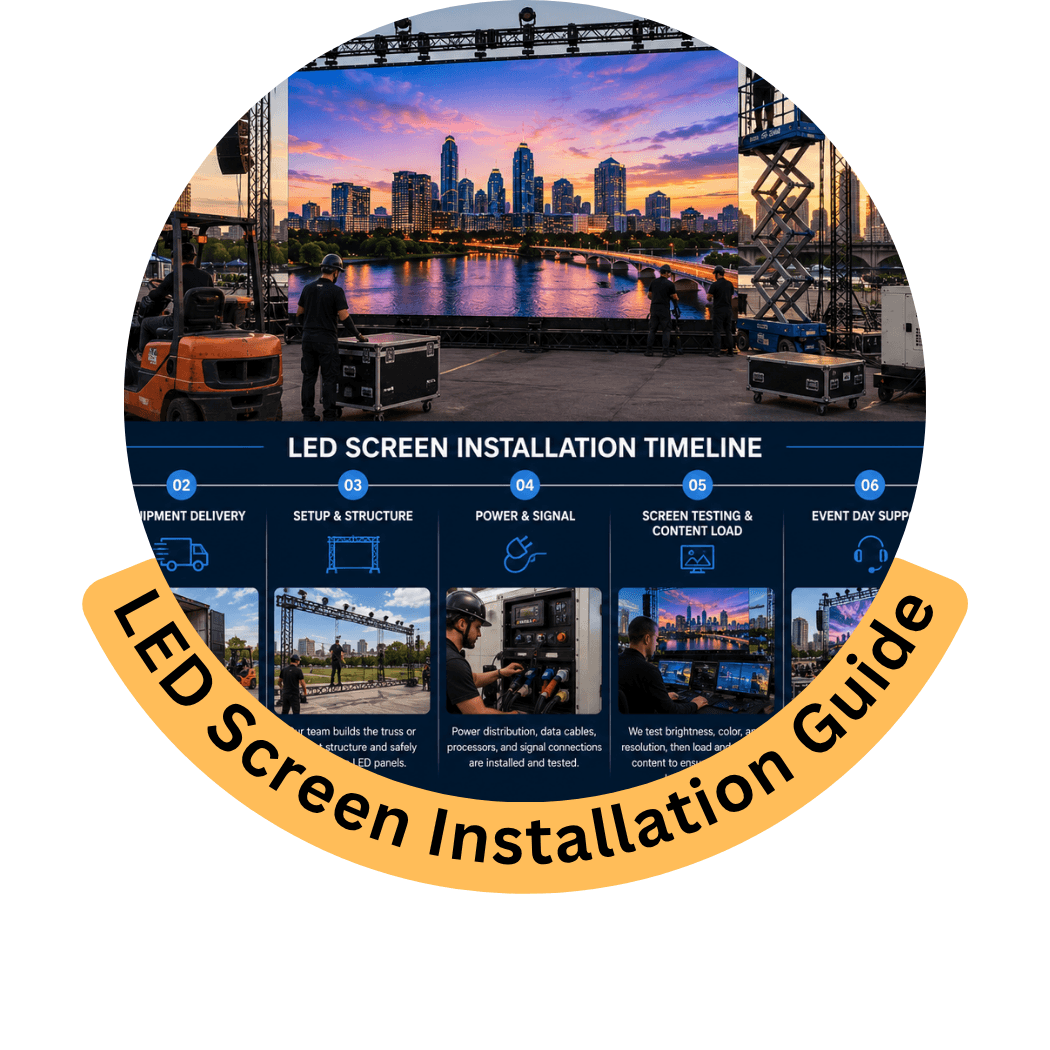
1. What Determines the Right LED Screen Installation Method?
The installation method depends on the LED wall dimensions, equipment, venue or site, stage design, available footprint, structural conditions, audience sightlines, and production requirements. We evaluate these factors before deciding how the display should be supported and positioned.
| Factor | What We Evaluate | Installation Impact |
|---|---|---|
| Screen Dimensions | Width and height | Determines overall system scale |
| LED Equipment | Cabinet design and configuration | Affects assembly and support |
| Venue / Site | Physical environment | Defines installation options |
| Stage Layout | Available production area | Influences screen positioning |
| Sightlines | Audience width and depth | Influences elevation |
| Structure | Approved support conditions | Determines feasible support method |
| Power | Available electrical service | Affects distribution planning |
| Signal | Control-to-screen routing | Affects data infrastructure |
| Access | Load-in and equipment paths | Influences installation workflow |
| Schedule | Build, test and rehearsal time | Determines crew planning |
Screen dimensions should be established before the installation system is finalized. Our LED Wall Size Guide explains how we determine the appropriate display size.
2. How Do We Plan an LED Screen Installation?
We plan an LED installation by defining the display configuration first and then coordinating the physical, structural, electrical, video, and operational requirements around it.
We Review the Event Requirements
We establish what the LED wall needs to accomplish during the production.
This includes requirements for:
- Presentations
- Video playback
- Camera IMAG
- Event branding
- Sponsor graphics
- Scenic content
- Live feeds
- Multiple content sources
The application influences screen dimensions, positioning, processing, and installation.
We Determine Screen Dimensions
We determine the physical width and height from audience size, viewing distance, stage dimensions, content, and available installation space.
We avoid selecting a wall simply because it fills the maximum available stage area.
We Select Pixel Pitch
Pixel pitch is selected according to the closest practical viewing distance, screen dimensions, content detail, and required native resolution.
Our LED Pixel Pitch Guide covers this selection process in greater detail.
We Determine Screen Position
We position the display around the stage and audience layout.
Our production team evaluates:
- Audience sightlines
- Stage height
- Screen elevation
- Scenic elements
- Speaker or performer positions
- Camera positions
- Lighting
- Other production equipment
For deeper audiences, we also consider whether supplemental displays are required.
We Determine the Support Method
Once the screen configuration and position are established, we determine whether an appropriate ground-supported or suspended configuration should be considered.
The final method depends on the actual equipment, site, structural conditions, and applicable requirements.
We Plan Power Distribution
We calculate LED power requirements from the actual cabinet configuration and applicable manufacturer data.
Power connection locations and distribution routes are coordinated with the physical installation rather than planned independently.
Our LED Power Requirements Guide explains this process further.
We Plan Signal Distribution
We determine how video signals travel from production control to the LED processors and display.
The workflow may include:
- Presentation computers
- Video switchers
- Media servers
- Cameras
- Playback systems
- Graphics
- LED processors
Signal routing depends on the production layout and equipment configuration.
We Coordinate Load-In
We review available access and the production schedule so equipment can be moved into position and assembled within the planned installation window.
Actual access procedures depend on the venue or event site and must be coordinated accordingly.
We Configure and Test the System
After physical installation, our technicians configure processors, establish the LED canvas, verify signal routing, test content, and check the complete display before live operation.
3. What Is a Ground-Supported LED Wall Installation?
A ground-supported LED wall uses an appropriate structural support system rather than suspending the display from an overhead structure. It can be useful when the event layout, venue, screen dimensions, and production design support this approach.
We evaluate:
- LED wall dimensions
- Complete display configuration
- Support structure
- Available footprint
- Floor or site conditions
- Screen elevation
- Audience sightlines
- Stage integration
- Power and data routing
- Access around the installation
Ground support should not be treated as structurally identical across every project. The appropriate system depends on the actual display and installation environment.
4. What Is a Truss-Hung LED Screen Installation?
A truss-hung LED screen is suspended using an appropriately designed and approved rigging system. Suspended installations can keep floor space available and provide positioning flexibility, but they require detailed structural and rigging coordination.
Depending on the project, qualified parties may need to verify:
- LED wall configuration
- Complete suspended load
- Truss system
- Motors
- Rigging hardware
- Attachment points
- Structural capacity
- Load distribution
- Applicable venue requirements
We never assume that a venue structure or rigging point can support an LED wall simply because overhead rigging is present.
Our Truss-Hung LED Screen Guide covers suspended LED installations in greater technical detail.
5. How Do We Determine the Correct LED Wall Height and Position?
We determine LED wall height and position from audience sightlines, stage dimensions, viewing distance, seating layout, screen dimensions, and potential obstructions.
A screen can have the correct physical dimensions but still perform poorly if positioned too low, too far to one side, or behind visual obstructions.
We evaluate both the closest and farthest practical audience positions.
For large Houston conferences, general sessions, galas, graduations, and entertainment productions, elevation can become especially important for attendees positioned farther from the stage.
Our LED Viewing Distance Guide explains how viewing geometry affects LED configuration.
6. How Do Power and Signal Distribution Affect LED Installation?
Power and signal distribution are integrated into the installation plan because both must reach the display reliably without conflicting with the stage, support system, audience areas, or production operations.
Power Distribution
We calculate electrical requirements from the actual LED equipment and supporting systems. Distribution is then planned according to the available electrical service and installation.
Signal Distribution
We establish signal paths between sources, production control, processors, and the LED wall.
Cable Routing
Power and signal cable routes are coordinated with:
- Stage layouts
- Support structures
- Equipment racks
- Production control
- Audience areas
- Technical access
- Other production systems
The exact routing and distribution requirements vary by installation.
7. What Do We Evaluate for an Outdoor LED Screen Installation?
Outdoor LED installation requires additional evaluation of the environment, screen position, equipment suitability, structural support, weather exposure, power distribution, site access, and operating conditions.
We assess:
- Outdoor suitability of the LED equipment
- Screen dimensions
- Audience viewing area
- Daylight conditions
- Screen orientation
- Site conditions
- Structural configuration
- Environmental exposure
- Electrical distribution
- Signal routing
- Installation access
Structural limits, ballast requirements, wind considerations, and operational limits must be established for the actual system by qualified parties where applicable. We do not apply universal limits to every outdoor installation.
Our Outdoor LED Screen Guide provides additional outdoor planning information.
8. How Do We Install and Align LED Cabinets?
We assemble LED cabinets according to the selected display configuration and manufacturer requirements. Accurate cabinet alignment is important because the individual cabinets must function as one continuous LED canvas.
During assembly, our technicians verify relevant factors such as:
- Cabinet positioning
- Mechanical connections
- Panel alignment
- Power connections
- Data connections
- Complete screen dimensions
- Display orientation
- Processor communication
After assembly, we inspect the complete display before moving into video configuration and content testing.
9. How Do We Configure the LED Wall After Installation?
Once the physical installation is complete, we configure the LED system around the actual cabinet layout and required content workflow.
LED Canvas Configuration
We establish the final pixel canvas based on the physical screen dimensions, cabinet configuration, and pixel pitch.
Video Processing
We configure professional LED processors for the required canvas, source positioning, scaling, and output mapping.
Content Mapping
Presentations, graphics, videos, and other sources are mapped to the intended areas of the display.
Camera & IMAG Integration
Where cameras are required, we integrate live feeds with the switching and processing workflow.
Playback Testing
Videos, graphics, presentations, and other important show content are checked on the installed display.
For presentation-heavy events, our PowerPoint on LED Screens Guide explains how presentation content is mapped to an LED canvas.
10. How Does Event Type Affect LED Screen Installation?
Different events create different installation requirements because screen position, stage design, audience layout, content, and production equipment change.
| Event Type | Typical Installation Focus | What We Evaluate |
|---|---|---|
| Corporate Event | Main stage LED | Presentations, stage, sightlines |
| Conference | Main LED + possible supplemental displays | Audience depth, IMAG |
| Trade Show | Booth LED installation | Footprint, close viewing, access |
| Product Launch | Stage/custom LED | Scenic integration, cameras |
| Gala / Awards | Stage LED backdrop | Stage design, IMAG, sightlines |
| Concert | Large-format LED | Stage integration, audience scale |
| Graduation | Main/supplemental LED | Audience depth, cameras |
| Outdoor Event | Outdoor LED system | Site, structure, environment |
These are planning examples rather than fixed installation methods. We determine the configuration from the actual event.
11. How Do Venue Access and Load-In Affect LED Installation?
Venue access can directly affect delivery, equipment movement, installation scheduling, and crew planning. We review the available load-in conditions before establishing the installation workflow.
For Houston event venues and sites, relevant considerations may include:
- Loading access
- Equipment travel paths
- Freight access where applicable
- Door and entry dimensions
- Installation area
- Stage access
- Production schedule
- Approved work periods
- Strike requirements
We do not assume that access conditions are identical across venues. Requirements are verified for the specific event location.
12. How Much Time Does an LED Screen Installation Require?
Installation time varies according to the screen dimensions, cabinet quantity, support method, venue access, power and signal distribution, processing, content requirements, crew configuration, and production schedule.
A compact ground-supported indoor wall and a large suspended production do not require the same installation workflow.
We account for time needed for:
delivery → assembly → power/data → processing → testing → content checks → rehearsal
We do not publish a universal installation time because the actual production requirements can vary significantly.
13. What LED Screen Installation Mistakes Do We Help Prevent?
LED installation problems often occur when the display is treated as standalone equipment instead of part of the complete event-production system.
Selecting Screen Size Before Reviewing the Venue
A proposed screen may conflict with the stage, audience layout, available footprint, or support conditions.
We verify the production environment before finalizing dimensions.
Ignoring Audience Sightlines
A properly assembled LED wall can still be ineffective if attendees cannot see it clearly.
We evaluate positioning and elevation before installation.
Assuming Overhead Rigging Is Available
The presence of overhead structure does not automatically establish that a proposed LED wall can be suspended from it.
Approved attachment conditions, loads, rigging equipment, and structural requirements must be verified.
Planning Power Too Late
The LED wall requires equipment-specific electrical planning. Waiting until installation to determine power can create unnecessary production complications.
We coordinate power during system design.
Ignoring Signal Paths
Processors and control systems may be located away from the LED wall.
We plan the complete source-to-display signal path before installation.
Building Before Confirming the LED Canvas
Physical dimensions and pixel pitch determine the native canvas.
We establish the configuration so processing and content can be prepared appropriately.
Skipping System Testing
Physical installation does not mean the display is show-ready.
We test processors, signals, content, cameras, playback, and the complete LED canvas before live operation.
14. How Do We Install LED Screens for Trade Shows and Exhibitions?
Trade show LED installations require close coordination with the booth footprint, display dimensions, attendee viewing distance, content, support system, power, and installation schedule.
Because attendees may approach the display closely, we also evaluate pixel pitch and physical screen position carefully.
We configure the LED wall around the exhibit design rather than treating it as an independent structure. Depending on the booth, this may involve a main Indoor LED Wall or another appropriate display configuration.
Installation and rigging requirements remain subject to the specific exhibition facility, event, booth design, and approved production plan.
15. How Do We Install LED Screens for Corporate Events and Conferences?
For corporate events and conferences, we typically integrate the LED wall with the main stage, presentation system, cameras, IMAG, and supporting production equipment.
We evaluate:
- Stage dimensions
- Audience depth
- Screen dimensions
- Pixel pitch
- Screen elevation
- Presentation content
- Camera positions
- Processing and switching
- Power and signal distribution
For deep audiences, we also determine whether supplemental displays are more effective than increasing the main wall dimensions.
16. Which LED Display Solutions Require Different Installation Approaches?
Different LED products require different deployment methods, footprints, and technical workflows.
Indoor LED Wall
We configure Indoor LED Walls around stage dimensions, viewing distance, pixel pitch, support method, content, and audience sightlines.
Outdoor LED Wall
Outdoor LED Walls require additional consideration of equipment suitability, site conditions, environmental exposure, structural support, power, and screen orientation.
Mobile LED Trailer
A Mobile LED Trailer uses an integrated mobile display platform rather than the same build process as a modular LED wall.
We evaluate access, positioning, audience orientation, site conditions, and the specific trailer system.
Kinetic Video Wall
Kinetic Video Walls require coordination between the physical display system, movement system, mapped content, control, and production design.
Sphere LED Wall
Sphere LED displays require a product-specific installation and content workflow based on the actual equipment and intended placement.
17. Does LED Screen Installation Affect Rental Cost?
Yes. Installation method can affect rental cost because different configurations require different support systems, rigging, labor, transportation, power distribution, equipment, installation time, and technical personnel.
A straightforward indoor ground-supported display may have a different production scope from a large suspended or outdoor LED installation.
Screen dimensions, pixel pitch, processing, cameras, rental duration, and supporting AV also contribute to the total rental configuration.
Our LED Screen Rental Cost Guide explains these pricing factors in greater detail.
18. How Do We Test an LED Screen After Installation?
After physical installation, we test the complete LED, processing, signal, content, and control workflow before the system is used for the live event. A structurally installed LED wall is not considered production-ready until its video system has also been configured and verified.
Our technicians check relevant elements such as:
- LED cabinet operation
- Complete LED canvas
- Processor configuration
- Source mapping
- Power and data connections
- Presentation inputs
- Video playback
- Camera and IMAG feeds
- Signal distribution
- Content positioning
- Supporting displays
Testing requirements vary according to the size and complexity of the production.
19. How Do We Handle LED Screen Content During Installation?
We configure content around the native LED canvas created by the final screen dimensions and pixel pitch. This allows presentations, graphics, videos, cameras, and other sources to be positioned correctly.
For custom LED dimensions, the canvas may not match a conventional television aspect ratio.
We can configure:
Full-Canvas Content
Graphics or video can be prepared for the complete native LED canvas.
Defined Presentation Areas
PowerPoint or other conventional sources can occupy a defined region without being unnecessarily stretched.
IMAG Windows
Camera feeds can be positioned according to the production design and audience requirements.
Multi-Source Layouts
Processors or media servers can combine presentations, cameras, graphics, and playback where required.
Content preparation and installation therefore need to be coordinated rather than treated as unrelated workflows.
20. How Do We Handle Rehearsal After LED Installation?
Rehearsal allows us to verify how the installed LED system performs with the actual event content and production workflow.
Depending on the production, we check:
- PowerPoint presentations
- Videos
- Graphics
- Camera IMAG
- Source transitions
- Playback cues
- Content layouts
- Speaker content
- Supporting displays
For complex corporate events and general sessions, rehearsal can also identify content changes or operational requirements that were not apparent during initial system testing.
21. What Must Be Verified Before a Truss-Hung LED Screen Is Installed?
Before suspending an LED wall, the complete proposed installation must be evaluated for the actual venue, equipment, structural conditions, and production design.
Relevant requirements may include:
| Requirement | What Must Be Verified |
|---|---|
| LED Configuration | Complete proposed display |
| Suspended Load | Actual system load |
| Truss | Appropriate system and configuration |
| Motors | Project-specific requirements |
| Rigging Hardware | Appropriate components |
| Attachment Points | Approved locations |
| Structure | Applicable structural capacity |
| Load Distribution | Complete suspended configuration |
| Venue Requirements | Project-specific requirements |
| Installation Procedure | Approved production workflow |
These are safety-critical considerations. We do not publish universal load capacities or assume that an attachment point is suitable without project-specific verification by qualified parties.
Our Truss-Hung LED Screen Guide provides more detailed suspended-display planning information.
22. What Must Be Verified Before an Outdoor LED Screen Is Installed?
Outdoor installation requires verification of both the display system and its operating environment.
We evaluate the actual:
- LED equipment
- Screen dimensions
- Support configuration
- Site conditions
- Audience area
- Screen orientation
- Environmental exposure
- Power distribution
- Signal routing
- Installation access
- Operating schedule
Wind, structural loading, ballast where applicable, equipment limitations, and other environmental requirements depend on the specific system and site. Required engineering or structural approval must be completed by qualified parties where applicable.
We do not use a universal wind or ballast figure for every outdoor LED wall.
23. How Do We Plan LED Screen Strike and Removal?
LED installation planning includes removal as well as setup. We coordinate strike around the event schedule, venue or site access, equipment configuration, and other production departments.
The workflow can include:
system shutdown → content/control equipment removal → power and signal disconnect → LED disassembly → support-system removal → equipment pack-out
For suspended systems, removal follows the approved rigging and production procedures applicable to the installation.
We also coordinate timing so LED removal works with staging, lighting, audio, and other production departments where required.
24. What Do We Verify Before Installing an LED Wall?
Before installation begins, we verify enough information to define the screen, support system, position, power, signal workflow, access, and production schedule.
| Information | What We Determine |
|---|---|
| Venue / Site | Installation environment |
| Event Date | Production scheduling |
| Screen Dimensions | Physical LED configuration |
| Pixel Pitch | Display configuration |
| LED Equipment | Cabinet and system requirements |
| Stage Dimensions | Available installation area |
| Audience Layout | Sightlines and positioning |
| Viewing Distance | Size and pitch requirements |
| Installation Method | Ground-supported or approved suspended approach |
| Structural Conditions | Project-specific support requirements |
| Power | Electrical planning |
| Signal Paths | Data and video distribution |
| Content | Processing and canvas requirements |
| Cameras / IMAG | Live-video integration |
| Load-In Access | Delivery and installation workflow |
| Rehearsal Schedule | Testing and content verification |
| Strike Schedule | Removal planning |
If screen dimensions have not yet been determined, our LED Screen Size Calculator can provide an initial estimate. We then verify the proposed size against the stage, audience, viewing distance, content, and installation environment.
For power planning, see our LED Power Requirements Guide. For outdoor systems, the Outdoor LED Screen Guide covers additional environmental and deployment considerations.
For a Houston event, provide the venue or site, event date, approximate screen requirement, stage information, audience size, and installation preference if known. Our production team can determine the remaining LED configuration, support, processing, power, signal, and installation requirements.